Foods That May Support Better Sleep
Only a few whole foods have been tested directly against human sleep outcomes, and the effects are modest. Here is what the trials show, what rests on mechanism alone, and how to use food sensibly alongside sleep timing, caffeine and alcohol.
No single food reliably fixes poor sleep. A small number of whole foods have actually been tested in human sleep trials, and a few show modest effects: tart cherries, kiwifruit, and plants supplying tryptophan, magnesium or trace melatonin. The more consistent finding is that a plant-rich overall eating pattern is associated with better sleep. Treat food as a supporting player alongside consistent sleep timing, morning light, and sensible caffeine and alcohol habits.
Key takeaways
- Only a handful of foods have been tested directly against sleep outcomes in humans, and most of those trials are small and short.
- Where effects appear, they are modest, roughly 20 to 40 extra minutes of sleep in the more favorable studies, not a treatment for insomnia.
- Melatonin and tryptophan in food occur at far lower amounts than in supplements, so a plausible mechanism does not guarantee a real-world effect.
- Higher adherence to a Mediterranean-style pattern is consistently associated with better sleep, although that evidence is observational.
- Caffeine dose and timing, plus evening alcohol, influence sleep more reliably than adding any single food.
How these foods were chosen
Most sleep food lists work backward from chemistry. A food contains tryptophan or magnesium, therefore it must help you sleep. That reasoning skips the step where somebody actually measures sleep.
The foods below were filtered in this order of preference:
- Tested in humans with sleep as the outcome. Controlled or interventional trials measuring sleep onset latency, total sleep time, sleep efficiency, or a validated questionnaire such as the Pittsburgh Sleep Quality Index.
- A measured biological signal, not just a theory. Studies that also tracked something objective, for example urinary 6-sulfatoxymelatonin, a marker of melatonin production.
- Part of a pattern already linked to sleep in population data, particularly Mediterranean-style, fiber-rich eating.
- Available and practical in the United States, in a portion a normal person would eat.
Foods resting on mechanism alone are labeled as such rather than quietly promoted.
The food list, and why each earns its place
Tart cherries
Tart cherries have the most direct evidence, and it is still modest. A 2025 systematic review of seven interventional studies found that five of six studies reporting sleep outcomes showed improvements in duration, efficiency or onset latency, with total sleep time increases ranging from about 22 to 84 minutes. Three of four studies measuring urinary 6-sulfatoxymelatonin found it rose, which supports the proposed mechanism.
The caveats are large. Samples ran from roughly 9 to 20 people. Doses ranged from 30 mL of concentrate to 240 mL of juice twice daily. An earlier meta-analysis found pooled self-reported sleep efficiency and total sleep time were not statistically significant, while objectively measured sleep efficiency was higher in cherry groups. Read this as a small, inconsistent signal worth testing, not a proven effect.
Kiwifruit
The most cited kiwifruit study asked 24 adults with sleep complaints to eat two kiwifruit an hour before bed for four weeks. Sleep onset latency fell about 35 percent, wake after sleep onset about 29 percent, and total sleep time rose about 13 percent. There was no placebo group, participants were almost entirely women, and expectation effects on self-reported sleep are strong. It is a cheap, low-risk personal experiment, not established fact.
Walnuts and pumpkin seeds
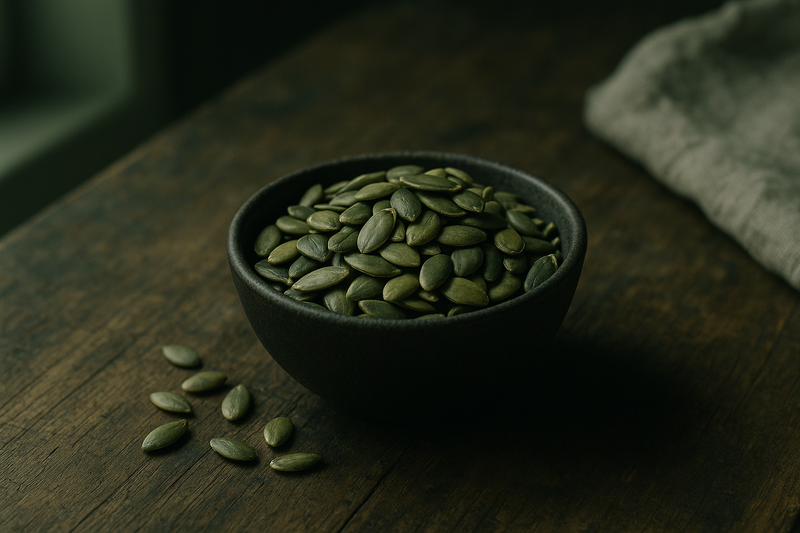
Walnuts and pumpkin seeds supply tryptophan, magnesium and trace melatonin. Tryptophan is the precursor to serotonin and then melatonin, which is why these appear on every list. In practice, dietary tryptophan competes with other large neutral amino acids for transport into the brain, so eating a tryptophan-rich food does not straightforwardly raise brain melatonin. This is mechanism, not outcome.
Oats and lentils
Oats provide slowly digested carbohydrate, magnesium and fiber. Lentils add fiber, magnesium and folate. Observational work links higher fiber intake with more deep sleep and fewer arousals, but these are associations among people who differ in many other ways. A small bowl of oats is a reasonable light evening food, not a sedative.
Foods that ride on the pattern
Bananas and extra virgin olive oil show up on sleep lists without direct trial support. They belong here only because they are components of the dietary pattern most consistently associated with better sleep. Do not expect either to do anything on its own.
How to actually use them
- Timing. Most protocols use tart cherry juice or kiwifruit roughly one hour before bed for at least two to four weeks. Sleep varies enormously night to night, so a single trial night proves nothing.
- Portions used in studies. Two kiwifruit, about 8 ounces of tart cherry juice, or roughly 30 mL of concentrate. More is not better and adds sugar.
- Keep the evening meal moderate. Large, heavy or very spicy meals close to bedtime commonly worsen reflux and fragment sleep. Aim to finish two to three hours before lights out.
- Handle caffeine first. In a randomized crossover trial, 100 mg taken up to four hours before bed had little measurable effect, while 400 mg within 12 hours of bedtime disrupted sleep. Pooled trial data suggest caffeine can cut total sleep time by roughly half an hour and reduce sleep efficiency by several percent.
- Be honest about alcohol. It shortens sleep onset and then fragments the second half of the night, reducing slow wave and REM sleep. A nightcap is not a sleep aid.
- Change one thing at a time and keep a two-week log.
Why the overall pattern matters more than any single food
A 2025 systematic review and meta-analysis pooled 62 studies covering 328,493 participants. Adequate sleep duration and good sleep quality were both associated with higher Mediterranean diet adherence, with odds roughly 38 to 39 percent higher, and early chronotypes showed a stronger association still.
That is a repeated signal with real limits. Every included study was observational. Poor sleep itself changes appetite and food choice, so causality could run in either direction, and unmeasured factors such as income, activity and stress plausibly drive both. The practical reading is not that eating this way will fix your sleep. It is that the pattern is worth building for several reasons, and better sleep may travel with it.
Who should adapt or be cautious
- Kiwifruit allergy. Kiwifruit is a common allergen with latex-fruit cross-reactivity. Skip it if you react to latex, avocado or banana.
- Blood sugar. Tart cherry juice is concentrated fruit sugar. If you are managing diabetes, prefer whole fruit or discuss the dose with your care team.
- Sensitive digestion. Kiwifruit, legumes and any sudden fiber increase can provoke gas and bloating. Ramp up slowly.
- Reflux. Late or acidic evening foods, cherry juice included, can worsen nighttime heartburn.
- Medication. Do not change or stop any prescribed sleep, mood or other medication based on a food article. Ask your prescriber.
When to seek care. Talk to a clinician about loud snoring with witnessed breathing pauses, gasping or choking at night, severe daytime sleepiness or falling asleep while driving, insomnia lasting more than three months, new insomnia alongside low mood, or uncomfortable leg sensations that force you to move at night. These point toward obstructive sleep apnea, chronic insomnia disorder or restless legs syndrome, none of which are food problems. Cognitive behavioral therapy for insomnia is the first-line treatment for chronic insomnia.
Bottom line
Tart cherries and kiwifruit are the only whole foods with meaningful direct human sleep data, and even there the studies are small and the effects modest. The rest of the usual list rests on mechanism. Build a plant-rich pattern, manage caffeine and alcohol, keep evening meals moderate, and treat any single food as a small experiment rather than a solution.
Frequently asked questions
Does tart cherry juice actually work for sleep?
Some trials show longer total sleep time and better objectively measured sleep efficiency, alongside increases in a urinary marker of melatonin production. Others show no significant change in self-reported sleep. Samples are small and doses vary widely. Trying it for two to four weeks is reasonable, and stopping if nothing changes is equally reasonable.
How much melatonin is in food compared with a supplement?
Far less. Plant foods contain melatonin in trace amounts, while typical supplements deliver milligram doses. Food-based melatonin is best understood as one small input among many, not as a dose of a sleep aid.
Is a melatonin supplement a better option?
The National Center for Complementary and Integrative Health notes melatonin may help with jet lag and delayed sleep-wake phase disorder, but that there is not enough strong evidence to recommend it routinely for chronic insomnia. Product labeling has also proved unreliable in testing. Discuss it with a clinician rather than self-escalating the dose.
Should I eat carbohydrates before bed?
Evidence is mixed. Some studies of high-glycemic evening meals report shorter sleep onset, but the effect is inconsistent and the foods involved are not ones worth adding for general health. A moderate, balanced evening meal finished a couple of hours before bed is the more defensible approach.
Can diet replace treatment for insomnia or sleep apnea?
No. Cognitive behavioral therapy for insomnia is first-line for chronic insomnia, and sleep apnea requires diagnosis and specific treatment. Diet may support sleep at the margins, but it is not a substitute for assessment and care.
Sources and evidence
- Melatonin: what you need to know, NCCIH
- Tart cherry and sleep quality, systematic review, 2025
- Tart cherries and sleep, systematic review and meta-analysis
- Kiwifruit consumption and sleep quality in adults with sleep problems
- Sleep and the Mediterranean diet, systematic review and meta-analysis
- Dose and timing effects of caffeine on subsequent sleep, randomized crossover trial
- Influence of dietary sources of melatonin on sleep quality, review
- CDC, about sleep and healthy sleep habits
- USDA FoodData Central, food composition database
Know Your Numbers
Eating healthy is a start. Now get to know your biomarkers.
Food changes bloodwork — inflammation, lipids, blood sugar and nutrient status all respond to what you eat. 59 markers from $59.
- Results in 7–10 days at 2,000+ Quest sites
- Licensed provider reviews every result
- One flat price, no membership, HSA/FSA eligible
Educational information only, not medical advice. Panels are ordered and reviewed through our licensed partner; Plantopedia may earn a commission.