Lingonberry — health benefits and uses
A Scandinavian staple, traditionally kept as a naturally preserving tart sauce.
The Short Answer
Lingonberries are tart, antioxidant-rich berries known for supporting urinary tract health and blood sugar regulation. They contain high levels of anthocyanins and proanthocyanidins, providing 15mg of Vitamin C per cup.
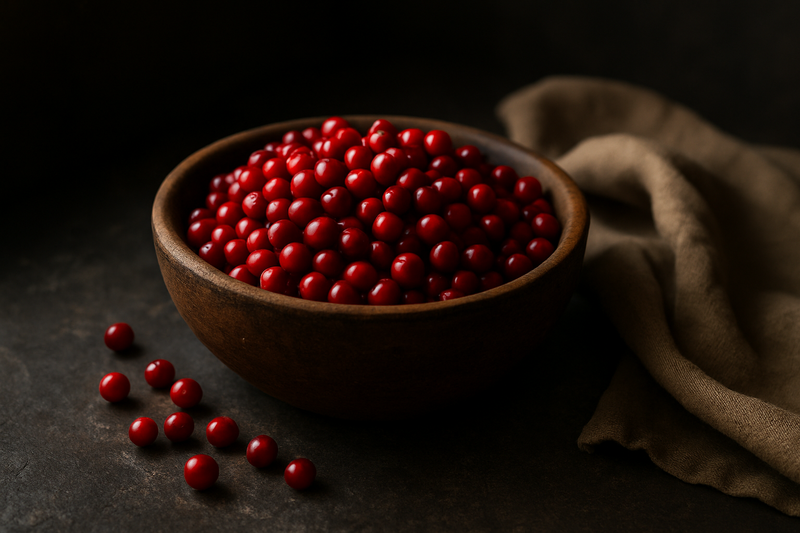
Lingonberry · Photograph
Discover the lingonberry health benefits backed by research: antioxidant-rich anthocyanins, blood sugar support, oral microbiome effects, and urinary tract health. Plus nutrition facts, safety notes, and easy ways to add this tart Nordic berry to your diet.
Key Nutrients
% Daily Value based on 2,000 cal diet
Key active compounds
- Anthocyanins (e.g., cyanidin-3-galactoside) — Water-soluble red pigments in the flavonoid family. They provide strong antioxidant capacity and, in early studies, may influence inflammatory pathways and support the health of blood vessel walls.
- Proanthocyanidins (type A and B) — Condensed tannins built from flavan-3-ol units. These are the compounds responsible for the astringent (mouth-drying) quality of tart berries. Type A proanthocyanidins in particular are associated with preventing certain bacteria from sticking to surfaces like the lining of the urinary tract.
- Flavonols (e.g., quercetin derivatives) — A class of flavonoids also found in onions, apples, and tea. They contribute antioxidant and anti-inflammatory activity in cell and animal models, and may play a role in vascular function.
- Phenolic acids (benzoic and cinnamic acid derivatives) — Simple phenolic compounds that support antioxidant defense and may help modulate microbial growth in the gut and oral cavity.
- Organic acids — Including citric and malic acid, which contribute to the berry's intense tartness and may play a minor role in its antimicrobial effects.
Prep and pairing ideas
Lingonberries are one of the most versatile savory-fruit ingredients in Nordic cooking, and their tartness makes them natural flavor enhancers rather than just sweet sides.
Three practical pairings:
- Lingonberries + fatty proteins (duck, venison, pork, salmon) — The acidity and tannins in lingonberries cut through richness and fat, making each bite feel lighter. This is the classic Scandinavian pairing and it works for a reason. A simple unsweetened or lightly sweetened sauce brings out the polyphenols without excessive sugar.
- Lingonberry powder + plain yogurt or oatmeal — Stirring a teaspoon or two of lingonberry powder into unsweetened yogurt or cooked oats adds tartness, color, and polyphenols with minimal added sugar. This mirrors the format used in the blood sugar study, so it is a practical, evidence-aligned breakfast choice.
- Frozen lingonberries + other Nordic or wild berries (bilberry, black currant) — Combining lingonberries with other dark berries gives you a broader range of anthocyanins and polyphenols. Use as a topping on pancakes or waffles, or blend into a smoothie. The variety matters — different berries carry different polyphenol profiles.
Quick kitchen tips:
- Rinse fresh or thawed frozen lingonberries gently; their skins are thin and bruise easily.
- To make a quick sauce without heavy sugar, simmer lingonberries with a splash of water and sweeten lightly with a small amount of honey or maple syrup.
- Lingonberry jam keeps well in the fridge for 2–3 weeks once opened; freeze homemade sauce in small portions.
Bottom line
Lingonberries are a genuinely nutritious whole fruit — low in calories, decent in fiber, and exceptionally rich in anthocyanins and proanthocyanidins that have well-established antioxidant and antimicrobial properties in the lab. Human research is still in its early stages: the most solid findings involve blood sugar modulation at a single meal and local oral health improvements from fermented lingonberry mouthwash. Potential benefits for the gut microbiome, cardiovascular risk markers, and skin are interesting but not yet confirmed in robust long-term trials.
The most practical, low-risk way to enjoy lingonberries is as a regular part of a varied, plant-rich diet — in whole or frozen form, used as a savory sauce alongside proteins, stirred into yogurt or oatmeal, or blended into smoothies. Watch the added sugar in commercial preparations, be aware of the interaction notes if you take certain medications, and don't expect any single food to work in isolation.
Lingonberries have earned their place in Nordic cooking over centuries. Modern science is slowly confirming what traditional cooks knew: this little red berry has more to offer than its tart bite suggests.
How Lingonberry Compares
| Compared with | What's different |
|---|---|
| Lingonberry vs. Cranberry | Larger, sweeter, and more watery; lingonberries are smaller, firmer, and more tart. |
| Lingonberry vs. Cowberry | Darker skin and softer texture; lingonberries have a brighter red color and higher acidity. |
Health Benefits
Things to Know
Sweetened products and blood sugar: Lingonberry sauce, jam, and syrup can be high in added sugars. People managing diabetes, insulin resistance, or weight should read labels and favor unsweetened or lightly sweetened versions.
Urinary tract and kidney health: Proanthocyanidins in lingonberries may support urinary microbiome health similarly to cranberry, but the evidence for preventing urinary tract infections is indirect and preliminary. People with a history of kidney stones should avoid very high intakes of concentrated berry products, though specific lingonberry data are limited.
Anticoagulant medications (e.g., warfarin): Polyphenols in berries can theoretically influence platelet function. No specific harmful interaction with warfarin has been documented for lingonberries, but it is sensible to mention high-dose supplement use to your prescriber.
Antidiabetic medications: Because lingonberry fiber and polyphenols may blunt postprandial glucose rises, people on insulin or glucose-lowering drugs who introduce large amounts of berry products or concentrated extracts should monitor blood sugar more closely.
Cholesterol-lowering medications: Preclinical data suggest lingonberry leaf extracts may have statin-like effects on LDL cholesterol handling in cells. No clinically significant interaction has been shown in humans, but inform your doctor if using high-dose supplements.
Pregnancy and breastfeeding: Normal food amounts of lingonberries are considered acceptable. High-dose extracts or concentrated medicinal preparations lack robust safety data for pregnancy; default to food-first use.
Acidity: Lingonberries are acidic. Fermented lingonberry juice as a mouthwash is well tolerated in short studies, but people with sensitive oral mucosa (the lining of the mouth), active mouth sores, or acid reflux may want to limit acidic berry juices.
Berry allergy: Anyone with known hypersensitivity to lingonberries or related Vaccinium species (blueberry, bilberry, cranberry) should exercise caution.

Prep Ideas
- — **Lingonberries + fatty proteins (duck, venison, pork, salmon)** — The acidity and tannins in lingonberries cut through richness and fat, making each bite feel lighter. This is the classic Scandinavian pairing and it works for a reason. A simple unsweetened or lightly sweetened sauce brings out the polyphenols without excessive sugar.
- — **Lingonberry powder + plain yogurt or oatmeal** — Stirring a teaspoon or two of lingonberry powder into unsweetened yogurt or cooked oats adds tartness, color, and polyphenols with minimal added sugar. This mirrors the format used in the blood sugar study, so it is a practical, evidence-aligned breakfast choice.
- — **Frozen lingonberries + other Nordic or wild berries (bilberry, black currant)** — Combining lingonberries with other dark berries gives you a broader range of anthocyanins and polyphenols. Use as a topping on pancakes or waffles, or blend into a smoothie. The variety matters — different berries carry different polyphenol profiles.
- — Rinse fresh or thawed frozen lingonberries gently; their skins are thin and bruise easily.
- — To make a quick sauce without heavy sugar, simmer lingonberries with a splash of water and sweeten lightly with a small amount of honey or maple syrup.
- — Lingonberry jam keeps well in the fridge for 2–3 weeks once opened; freeze homemade sauce in small portions.
Glossary
Shop This Ingredient
Stock your pantry with quality lingonberry.
Buy on AmazonAs an Amazon Associate, Plantopedia earns from qualifying purchases. This costs you nothing extra and helps us keep the encyclopedia free.
Frequently Asked Questions
Heart and circulation There are currently no long-term clinical trials testing lingonberries alone for blood pressure, cholesterol levels, or cardiovascular events. What exists is promising but still early-stage. Lab studies on cell cultures found that aqueous (water-based) extracts of lingonberry leaves — not the fruit itself — increased the expression of LDL receptors (proteins on liver cells that help clear "bad" LDL cholesterol from the blood), producing effects comparable in that cell model to the cholesterol-lowering drug lovastatin. Animal studies at Lund University in Sweden found that mice fed a high-fat diet along with lingonberries were protected from weight gain, elevated blood lipids, and poor glucose tolerance compared to mice without lingonberry supplementation. These findings cannot be directly applied to people eating lingonberry sauce with their meatballs. That said, including a variety of berries in your diet is consistently associated with better cardiometabolic health in population research, and lingonberries fit naturally into that pattern. Digestive health and gut microbiome A randomized controlled trial in children testing cranberry-lingonberry juice found measurable shifts in the composition of gut and urinary microbiota — the communities of microorganisms living in the digestive and urinary tracts. Because the juice combined both berries, it is not possible to assign the effect to lingonberry alone, but the study supports the idea that polyphenol-rich berry combinations influence microbial ecosystems in the body. Lingonberry's fiber and phenolic acids are also thought to act as prebiotics — substances that selectively feed beneficial gut bacteria — though dedicated human GI trials focused only on lingonberry have not yet been published. Fermented lingonberry juice used as a mouthwash in oral health studies reduced pathogenic (disease-causing) bacteria and yeast in the mouth, which is the upper end of the digestive tract. Blood sugar and metabolism This is the area with the most directly relevant human data. A crossover trial (a study design where the same participants test each condition in turn) in healthy men added commercial lingonberry powder to yogurt meals that also contained 50 g of added glucose. Even though the berry meal contained more total carbohydrate, the postprandial (after-meal) blood glucose and insulin responses were no higher than the control meal — suggesting that lingonberry's fiber and polyphenols were offsetting the glycemic impact of the added sugars. However, when the same lingonberry powder was tested alongside a high-fat meal without added glucose, the blood sugar response was slightly higher, not lower. So the blood sugar benefit appears to be context-dependent — most relevant when lingonberries accompany a carbohydrate-containing meal. This was a single small acute study in healthy men only; there is no long-term data and no data in people with diabetes or insulin resistance. Lingonberries should never replace established diabetes management. Inflammation and recovery Most anti-inflammatory evidence for lingonberries is from cell and animal studies, where lingonberry phenolics have been shown to modulate key inflammatory signaling pathways. The clearest human evidence comes from a series of small oral health studies. In these trials, fermented lingonberry juice (FLJ) used as a mouthwash (10–20 mL twice daily for 1–2 weeks) reduced dental plaque and signs of gingival inflammation (gum inflammation) compared to baseline. A 30-day pilot study using an FLJ spray reported improvements in periodontal indices — measures of gum tissue health — as well as reductions in a biomarker called active matrix metalloproteinase-8, which is associated with active gum tissue breakdown. These are local, targeted effects in the mouth. There is no robust human evidence yet that eating lingonberries reduces systemic (whole-body) inflammation markers like CRP.
The honest answer is: for everyday eating, whole or frozen unsweetened lingonberries give you the full package — fiber, vitamins, and polyphenols — with no added sugar or processing. Here is a quick breakdown of your main options: Fresh or frozen whole berries — Best choice for whole-food nutrition. Frozen lingonberries retain their polyphenol content well and are widely available outside Scandinavia. No added sugar. Lingonberry sauce or jam — The classic Nordic preparation, but heavily sweetened to tame the tartness. Many of the phenolics survive cooking, but the added sugars may counteract metabolic benefits if consumed in large quantities. Fine as a condiment; less ideal as a health food by the spoonful. Lingonberry powder — Used in the glycemia trial. Convenient for adding to smoothies, oatmeal, or yogurt; delivers concentrated fiber and polyphenols. Check for added sugars on the label. Fermented lingonberry juice (FLJ) — Currently a research product more than a consumer product; studied specifically for oral health as a mouthwash or spray. Standardized extract in supplement drinks — Used in a 12-week skin trial, usually combined with other botanicals like amla. The independent contribution of lingonberry is not established, and long-term safety of high-dose extracts has not been studied thoroughly.
The polyphenol-curious eater who already eats well Wants to diversify their berry intake beyond blueberries and strawberries. Comfortable with a tart flavor and enjoys experimenting in Nordic-style cooking. Interested in gut microbiome support and prebiotic variety from whole food sources. The person managing blood sugar through diet Looking for low-glycemic additions to meals that still provide fruit nutrients. Wants to use the whole-fruit form (fresh, frozen, or powder) rather than sweetened sauces. Benefits from pairing lingonberries with higher-carbohydrate meals based on the acute glycemia trial findings — though should work with a healthcare provider on overall meal planning.
There is no established official recommended dose for lingonberries as a therapeutic food. Here is what the available research and traditional use suggest: For everyday whole-food use: Around 50–100 g (roughly ½–1 cup) of fresh or frozen lingonberries several times per week fits within standard fruit-intake guidelines from MyPlate and similar guidance. This provides a meaningful polyphenol dose without excess sugar. In clinical studies: The blood sugar crossover trial used a single meal with commercial lingonberry powder (equivalent to about 50–75 g berries) added to yogurt. The skin trial used 25–50 mg of standardized lingonberry extract per day for 12 weeks — a concentrate far smaller by weight than whole fruit. The oral health studies used 10–20 mL of fermented lingonberry juice as a mouthwash twice daily — not ingested as food. One ongoing pilot trial is testing 200 g per day for 7 days to examine gut microbiota and signaling markers. Start low if you are new to them: Lingonberries are high in tannins and organic acids. If you are not used to them, large amounts at once can cause mild GI upset or a sour stomach in some people. Start with a couple of tablespoons of sauce or a small handful of berries and build up. Note on sweetened products: If your lingonberry intake is mainly via jam or commercial sauce, check how many grams of added sugar are in your typical serving. The berry itself is not high in sugar, but some commercial sauces are. Looking to explore more evidence-based ways to support your health through food? Browse our goals guides for curated approaches by health area.
Quick Answers
Common questions, answered in a line.
Lingonberries contain anthocyanins, proanthocyanidins, flavonols, phenolic acids, and organic acids like citric and malic acid. These compounds provide antioxidant capacity and give the berry its characteristic tartness and astringent quality.
You can use lingonberries as a savory sauce for fatty proteins like duck or salmon, stir lingonberry powder into yogurt or oatmeal, or blend frozen berries into smoothies. Their acidity acts as a natural flavor enhancer that cuts through the richness of meats.
Lingonberries may support blood sugar management by blunting the rise of glucose after a meal. This effect is attributed to the fruit's fiber and polyphenol content, which were highlighted in specific blood sugar studies.
People taking anticoagulant medications like warfarin or antidiabetic drugs should exercise caution and consult a doctor before using high-dose lingonberry supplements. The berries can theoretically influence platelet function and blood sugar levels, potentially interacting with these treatments.
Lingonberries contain type A proanthocyanidins, which may help prevent certain bacteria from sticking to the lining of the urinary tract. While research is preliminary compared to cranberries, these compounds are known to support urinary microbiome health.
Research suggests that fermented lingonberry mouthwash may support oral health by influencing the oral microbiome. However, because the berries are acidic, individuals with sensitive oral mucosa or active mouth sores should use them with caution.
While lingonberries are generally safe in food amounts, there is a lack of robust safety data regarding high-dose extracts or concentrated preparations during pregnancy. It is recommended to stick to whole food portions rather than medicinal supplements during this time.
For Readers in the USA
Local context — sourcing, seasonality, and regional notes.
In the United States, you can find frozen lingonberries or jarred preserves most consistently at IKEA food markets and specialty grocers like Whole Foods or Trader Joe's. While fresh berries are rare in standard supermarkets, online retailers often ship frozen wild-harvested lingonberries from the Pacific Northwest or Northeast.
Wild lingonberries, often called mountain cranberries or cowberries in the U.S., grow natively in Alaska and northern states like Washington, Maine, and Minnesota. In these regions, the peak foraging season typically runs from late August through September, depending on the local climate and elevation.
The USDA Organic seal ensures lingonberries were grown without synthetic fertilizers or pesticides, though many U.S. consumers prefer "wild-harvested" labels which imply the berries were picked from their natural habitat. When buying imported Nordic brands, look for the FDA-required nutrition facts panel to check for high levels of added cane sugar often found in traditional preserves.
While commonly known by their Swedish name, lingonberries are also referred to as "lowbush cranberries" or "partridgeberries" in Alaska and parts of New England. These regional names often appear at local farmers markets or in North American indigenous culinary traditions where the berry is used in similar ways to the commercial cranberry.
AI Clinical Review
- Clearly explains that lingonberries are a low‑calorie, fiber‑ and vitamin C–containing fruit rich in polyphenols (anthocyanins and proanthocyanidins), and emphasizes whole, unsweetened forms over sugary sauces.
- Accurately distinguishes lab/animal findings from human data and avoids disease‑treatment claims.
- Summarizes the most relevant human signals: modest blunting of post‑meal glucose in one small trial and local oral‑health benefits from fermented lingonberry juice used as a rinse.
- Offers practical serving guidance (about 50–100 g several times per week) that fits within general fruit‑intake recommendations.
- Cardiovascular outcomes (blood pressure, LDL, events) lack long‑term randomized trials; most support is preclinical or from general “berry‑rich diet” patterns.
- Urinary health claims are largely extrapolated from cranberry; lingonberry‑specific human prevention/treatment data are minimal.
- Glycemic effects come from a single, small crossover study in healthy men and appear context‑dependent; there’s no long‑term data or studies in diabetes.
- Microbiome and skin findings rely on preliminary work or combination products, so the independent effect of lingonberry remains uncertain.
- Form matters: whole or frozen berries and unsweetened powders deliver fiber and polyphenols without added sugars; jams/sauces can be high in added sugar—check labels.
- Practical intake: starting with ~½–1 cup (≈50–100 g) on several days per week is reasonable; safety of high‑dose extracts or concentrated products isn’t well established.
- Use extra caution and consider clinician input if you take anticoagulants (e.g., warfarin) or glucose‑lowering medications, or if you have a history of kidney stones.
- Their acidity and tannins can irritate sensitive stomachs or mouths; note that fermented lingonberry juice has been studied as a mouth rinse, not a daily beverage.
Very tart; usually sweetened. Generally very safe.
References
- USDA FoodData Central — lingonberry nutritional data (fdc.nal.usda.gov)
- MyPlate fruit guidance — context for daily fruit intake recommendations (myplate.gov)
- Comprehensive review: lingonberry phenolics, microbiome, and inflammation (PMC, 2024) (pmc.ncbi.nlm.nih.gov)
- RCT: lingonberry + amla extract drink improved skin elasticity and hydration in healthy women over 12 weeks (PubMed, 2019) (pubmed.ncbi.nlm.nih.gov)
- Review: lingonberry general and oral effects on microbiome and inflammation (Nutrients, 2021) (mdpi.com)
- RCT (pediatric): cranberry-lingonberry juice and gut/urinary microbiota changes (Cochrane Central) (cochranelibrary.com)
- Human crossover trial: lingonberry fiber/polyphenols blunt glycemic response in healthy men (PubMed, 2012) (pubmed.ncbi.nlm.nih.gov)
- Lund University experimental study: lingonberries halt high-fat diet effects in mice (lunduniversity.lu.se)
- In vitro study: lingonberry leaf extracts lower cellular cholesterol and increase LDL receptor expression (Food & Function, 2021) (pubs.rsc.org)
- Ongoing RCT: effect of 200 g/day lingonberries on extracellular vesicle signaling and gut microbiota (ClinicalTrials.gov) (clinicaltrials.gov)
Know Your Numbers
Eating healthy is a start. Now get to know your biomarkers.
Food changes bloodwork — inflammation, lipids, blood sugar and nutrient status all respond to what you eat. 59 markers from $59.
- Results in 7–10 days at 2,000+ Quest sites
- Licensed provider reviews every result
- One flat price, no membership, HSA/FSA eligible
Educational information only, not medical advice. Panels are ordered and reviewed through our licensed partner; Plantopedia may earn a commission.