Wild Berries: Antioxidants, Evidence & Foraging
Why wild berries test far higher in anthocyanins than cultivated fruit, which health claims hold up in trials, and a full index of the foraged berries covered on Plantopedia.
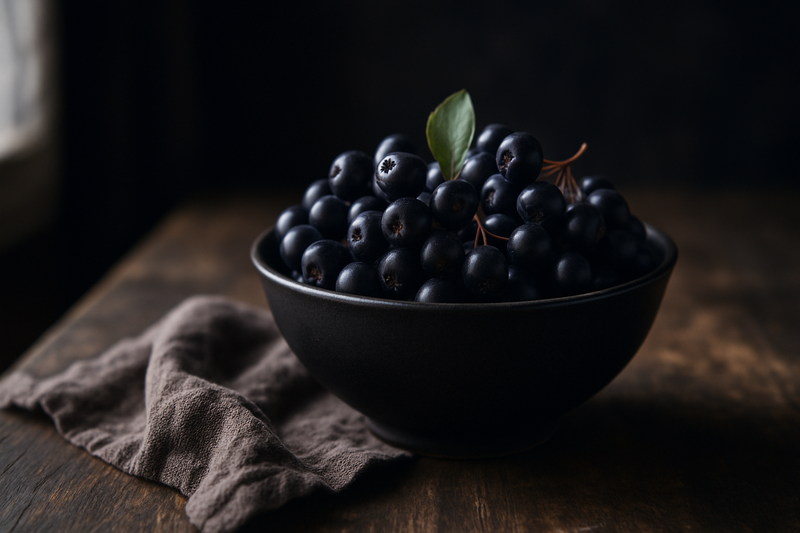
Wild and foraged berries carry the same basic profile as cultivated ones — low sugar, high fiber, high vitamin C — but they concentrate polyphenols far more heavily. Plants growing without irrigation, fertilizer, or selection for size produce smaller fruit with a higher skin-to-flesh ratio, and the skin is where anthocyanins live. Measured total anthocyanin content in wild Bilberry commonly runs several times that of a cultivated blueberry.
This hub covers every wild, foraged, and traditionally gathered berry on Plantopedia, plus what the evidence actually supports for each.
Why wild berries test higher in antioxidants
- Skin-to-flesh ratio. Small fruit means proportionally more pigmented skin per gram.
- Stress chemistry. Anthocyanins and other phenolics are partly a UV and cold-stress response, so plants in harsh northern or alpine habitats make more of them.
- No selection for sweetness. Breeding for size and sugar dilutes the phenolic fraction, which is why the sharpest-tasting berries — Aronia berry, Lingonberry, Cranberry — test the highest.
The wild berry index
- Aronia berry — habitat, season, nutrition, and evidence summary
- Bilberry — habitat, season, nutrition, and evidence summary
- Cloudberry — habitat, season, nutrition, and evidence summary
- Lingonberry — habitat, season, nutrition, and evidence summary
- Huckleberry — habitat, season, nutrition, and evidence summary
- Salmonberry — habitat, season, nutrition, and evidence summary
- Thimbleberry — habitat, season, nutrition, and evidence summary
- Saskatoon berry — habitat, season, nutrition, and evidence summary
- Serviceberry — habitat, season, nutrition, and evidence summary
- Buffaloberry — habitat, season, nutrition, and evidence summary
- Elderberry — habitat, season, nutrition, and evidence summary
- Mulberries — habitat, season, nutrition, and evidence summary
- Barberry — habitat, season, nutrition, and evidence summary
- Goji berries — habitat, season, nutrition, and evidence summary
- Gooseberries — habitat, season, nutrition, and evidence summary
- Cranberry — habitat, season, nutrition, and evidence summary
What the evidence actually supports
Three claims have reasonable human trial support. Cranberry's A-type proanthocyanidins reduce recurrence of uncomfortable urinary infections in susceptible people by interfering with bacterial adhesion. Elderberry preparations have shown modest reductions in cold and influenza symptom duration, though trial quality is mixed. Anthocyanin-rich berries generally show small improvements in flow-mediated dilation and post-meal glucose response.
Claims that do not hold up as well: bilberry for night vision — the wartime story is folklore and controlled trials are largely negative — and any single berry marketed as a metabolic cure. Treat "superberry" positioning as marketing.
Foraging safely
Positive identification is non-negotiable: several toxic species mimic edible berries, and elderberry in particular must be cooked, since raw berries, leaves, and stems contain cyanogenic glycosides. Harvest away from roadsides and sprayed margins, take only what a patch can spare, and check local regulations before gathering on public land. When you are not certain of an identification, do not eat it.
Using them
Wild berries freeze well and lose little of their anthocyanin content in the process — freezing actually ruptures cells and makes the pigments more extractable. Tart species such as lingonberry, aronia, and barberry are better cooked into sauces, syrups, and grain dishes than eaten out of hand. Dried varieties like Goji berries and Barberry concentrate sugar along with pigment, so treat them as a garnish rather than a serving of fruit.
Frequently asked questions
Are wild berries healthier than cultivated berries?
They are typically higher in anthocyanins and other polyphenols, often by a factor of two to five, because they are smaller and have proportionally more pigmented skin. Macronutrients, fiber, and vitamin C are broadly similar, so the advantage is concentration of phenolics rather than a different nutrient class.
Which wild berry has the most antioxidants?
Aronia (chokeberry) consistently measures highest among commonly available species, followed by wild bilberry and elderberry. Astringency is a rough guide: the more mouth-puckering the berry, the higher its proanthocyanidin content.
Can you eat elderberries raw?
No. Raw elderberries, along with the leaves, stems, and unripe fruit, contain cyanogenic glycosides that can cause nausea, vomiting, and diarrhea. Cooking destroys them, which is why elderberry is consumed as syrup, jam, or a cooked preparation.
Do frozen wild berries lose their antioxidants?
Very little. Freezing preserves anthocyanin content well and ruptures cell walls, which can actually increase how much pigment is released when the fruit is eaten or cooked.
How do I know a foraged berry is safe?
Identify the plant by multiple features — leaf, stem, growth habit, and habitat — not by fruit appearance alone, and cross-check against a regional field guide or an experienced local forager. If any doubt remains, do not eat it.
Know Your Numbers
Eating healthy is a start. Now get to know your biomarkers.
Food changes bloodwork — inflammation, lipids, blood sugar and nutrient status all respond to what you eat. 59 markers from $59.
- Results in 7–10 days at 2,000+ Quest sites
- Licensed provider reviews every result
- One flat price, no membership, HSA/FSA eligible
Educational information only, not medical advice. Panels are ordered and reviewed through our licensed partner; Plantopedia may earn a commission.