Gac Fruit — health benefits and uses
A Vietnamese ceremonial fruit prized for its carotenoid-rich red aril.
The Short Answer
Gac fruit is a nutrient-dense fruit from Southeast Asia known for having the highest concentrations of lycopene and beta-carotene of any known fruit. Only the dark red fleshy aril surrounding the seeds is consumed, typically mixed into sticky rice or

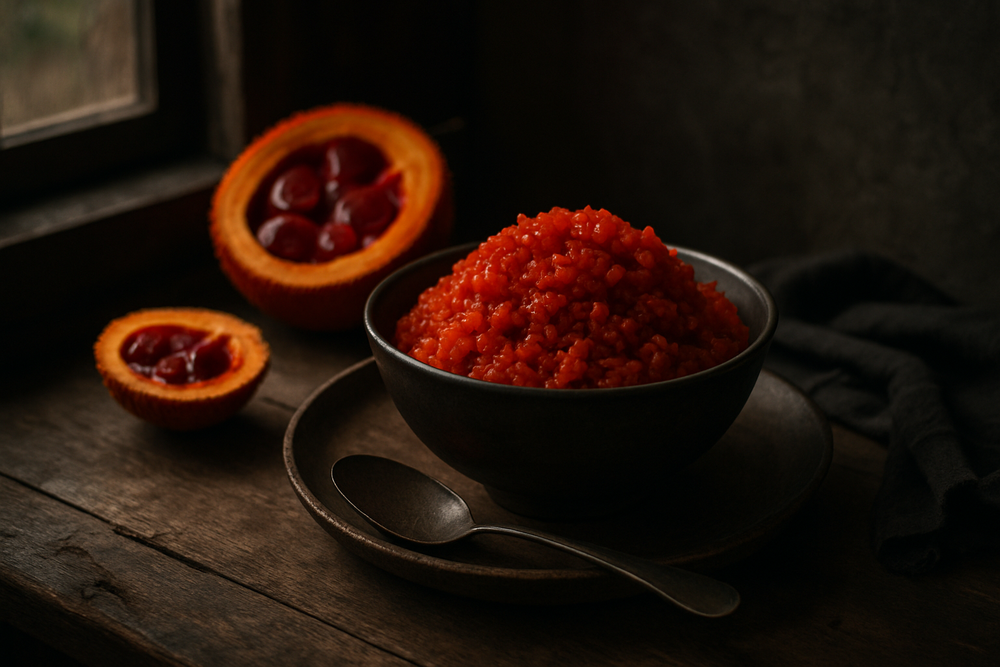
Gac Fruit · Photograph
Discover the gac fruit health benefits, nutrition facts, and how this deep-red Vietnamese fruit delivers record-breaking levels of lycopene and beta-carotene. Learn how to use the aril in xoi gac sticky rice, what the science says, and why only the red pulp is eaten.
Key Nutrients
% Daily Value based on 2,000 cal diet
Key active compounds in gac fruit aril
- Lycopene — A red, fat-soluble carotenoid and potent antioxidant (a compound that neutralizes damaging molecules called free radicals). Gac aril contains lycopene concentrations far exceeding those in tomatoes, and simulated digestion studies show it is released and absorbed at a much higher rate from gac than from tomato or carrot.
- Beta-carotene — An orange provitamin A carotenoid the body converts into retinol (the active form of vitamin A). It supports vision, immune defense, and the health of skin and mucous membranes. Gac aril is one of the richest known food sources.
- Alpha-carotene — A structural cousin of beta-carotene with its own provitamin A activity and antioxidant properties, present in smaller amounts in the aril.
- Tocopherols (including alpha-tocopherol / vitamin E) — Lipid-phase antioxidants found alongside carotenoids in the aril, potentially providing synergistic protection against oxidative damage.
- Aril fatty acids — The lipid-rich oil matrix of the aril is not just a calorie source; it appears to be a critical vehicle that keeps carotenoids dissolved and ready for absorption during digestion. This natural fat-carotenoid pairing is one reason gac outperforms isolated carotenoid powders in some studies.
Prep and pairing ideas
Xoi gac (Vietnamese festive sticky rice) — Scoop the fresh red aril from the halved gac fruit, mix it thoroughly with soaked glutinous rice, add a small amount of salt and a teaspoon of coconut oil or lard if desired, then steam until the rice is fully cooked and evenly colored a deep red-orange. The fat from the aril and any added oil enhances carotenoid absorption. Serve warm. This is the traditional Lunar New Year and wedding preparation.
Gac aril smoothie base — Blend a tablespoon of fresh or thawed frozen aril into a smoothie with mango, coconut milk, and a squeeze of lime. The coconut milk provides fat for carotenoid absorption and balances the subtle, slightly grassy flavor of the aril.
Gac powder-fortified rice porridge (cháo) — Stir half a teaspoon of freeze-dried gac aril powder into a plain rice porridge (congee) along with a few drops of sesame oil. This is a practical, low-effort way to add provitamin A to a simple, easy-to-digest meal — especially useful for young children or elderly family members.
Buying guide: fresh, frozen, dried, and supplement forms
Fresh gac fruit is available in Vietnamese markets and some Asian grocery stores across North America, Australia, and Europe, typically between October and January when the fruit is in season. Look for deep-red to reddish-orange skin with soft spines; overripe fruit will be very soft and may have off odors. The aril should be vivid scarlet-red — dull or brown coloration may indicate oxidation.
Frozen aril is increasingly available at Vietnamese and Southeast Asian grocery stores and online. Freezing preserves carotenoid content well. This is the most practical option for cooks outside Southeast Asia. Thaw in the refrigerator and use immediately.
Dried aril powder is available from specialty food suppliers and some supplement brands. Look for products that specify freeze-drying (which better preserves lycopene than heat drying) and that list carotenoid content per serving. Avoid powders with long ingredient lists or added fillers.
Gac oil and extracts / supplements vary enormously in quality and concentration. Look for products that provide a Certificate of Analysis (CoA) confirming lycopene and beta-carotene content per dose. Be cautious of products making disease treatment claims — these are not supported by current evidence.
Bottom line
Gac fruit stands out in the plant food world for one compelling reason: its red aril contains concentrations of lycopene and beta-carotene that dwarf those of tomatoes and carrots, packaged inside a naturally fatty matrix that makes those carotenoids exceptionally easy for the body to absorb. The strongest human evidence supports its use as a food-based strategy to improve vitamin A and carotenoid status, particularly in populations where vitamin A deficiency is a concern. Beyond carotenoid and vitamin A nutrition, the cardiovascular, anti-inflammatory, and metabolic benefits commonly attributed to gac remain extrapolated from general carotenoid science rather than gac-specific clinical trials — promising, but not yet proven.
The safest and most evidence-aligned way to use gac is also the most culturally authentic: as a culinary ingredient, particularly in xoi gac, where small amounts of aril color and enrich a whole-grain dish while delivering a potent, naturally bioavailable dose of the most studied carotenoids in human nutrition. Only the red aril pulp is edible — the seeds are not eaten.
If you're building a diet rich in plant-based carotenoids, gac fits beautifully alongside other colorful whole foods.
→ Explore our full guide to antioxidant-rich foods and plant-forward eating to see where gac fits into a broader food-as-medicine approach.
How Gac Fruit Compares
| Compared with | What's different |
|---|---|
| Gac Fruit vs. Tomato | Gac fruit contains up to 70 times more lycopene per gram than a standard tomato. |
| Gac Fruit vs. Carrot | Gac fruit provides significantly higher beta-carotene levels and a milder, grassier flavor. |
| Gac Fruit vs. Durian | Gac is prized for its red aril and antioxidants, whereas Durian is known for its pungent aroma and fat. |
Health Benefits
Things to Know
Seeds are not for eating.: Only the red aril (the fleshy membrane surrounding the seeds) is consumed. The seeds are hard and not eaten raw or cooked in food preparations; traditional external uses exist but are separate from culinary use. Do not swallow the seeds.
Carotenoids are fat-soluble.: You absorb them far better when gac is eaten alongside fat — which the aril naturally provides when mixed into sticky rice or cooked with a small amount of oil.
Not preformed vitamin A.: The vitamin A precursors in gac (beta-carotene and alpha-carotene) must be converted by the body into active vitamin A (retinol). Conversion efficiency varies between individuals. Gac does not carry the same toxicity risk as preformed vitamin A found in liver or supplements.
Carotenodermia: — At very high intakes of carotenoid-rich foods, a harmless yellowing of the skin (carotenodermia) can occur. It is reversible when intake is reduced. This is cosmetic, not toxic.
High-dose supplements and smokers.: High-dose isolated beta-carotene supplements (not food) have been associated with increased lung cancer risk in heavy smokers in some trials. Food-based beta-carotene, including from gac, is not thought to carry the same risk, but people who smoke heavily and are considering high-dose gac extracts or supplements should discuss this with a healthcare provider.
Cucurbitaceae family.: Gac is related to gourds, squash, and melons. People with known allergies to this plant family should use caution.
Pregnancy.: Gac used as a traditional food ingredient in typical serving sizes is generally considered safe, and improving vitamin A status is nutritionally valuable during pregnancy. However, high-dose concentrated gac extracts or supplements have not been studied in pregnant individuals, so typical culinary use is preferable.
Retinoid medications.: If you take prescription retinoids (medications derived from vitamin A, used for skin conditions or certain cancers), consult your doctor before adding large amounts of gac-based supplements, as combined effects on vitamin A status are not well characterized.
Fat malabsorption conditions.: People with conditions that impair fat absorption (e.g., certain pancreatic or bowel diseases) may not absorb gac's carotenoids as efficiently as expected.
Glossary
Shop This Ingredient
Stock your pantry with quality gac fruit.
Buy on AmazonAs an Amazon Associate, Plantopedia earns from qualifying purchases. This costs you nothing extra and helps us keep the encyclopedia free.
Frequently Asked Questions
Eye health and vitamin A support This is the area with the strongest human evidence. A 30-day randomized trial conducted in Vietnam enrolled 193 preschool children at risk of vitamin A deficiency and divided them into three groups: one received sticky rice with food-grade color (control), one received sticky rice with 5 mg synthetic beta-carotene powder, and one received traditional xoi gac providing approximately 3.5 mg of natural beta-carotene per serving. The children eating xoi gac showed significantly greater increases in plasma (blood) levels of beta-carotene, lycopene, alpha-carotene, zeaxanthin, and retinol than those receiving either the control or synthetic beta-carotene. This suggests that food-matrix carotenoids from gac are more effectively absorbed and utilized than isolated synthetic equivalents — a meaningful finding for populations where vitamin A shortfalls affect night vision, immune function, and growth. It is important to note that the outcomes measured were biochemical markers (carotenoid and retinol levels in the blood), not clinical endpoints like reduced rates of night blindness or infection. Still, improving vitamin A status through food is a validated nutritional strategy, and gac appears to be an especially efficient vehicle. Antioxidant support and inflammation Gac aril's combination of lycopene, beta-carotene, alpha-carotene, and vitamin E creates a formidable antioxidant profile on paper. Laboratory (in vitro) digestion models confirm that lycopene and beta-carotene from gac are liberated and become bioaccessible at much higher percentages than from carrot or tomato — meaning the body has more of these antioxidants available to neutralize oxidative stress (cellular damage caused by free radicals). However, there are no published human clinical trials directly measuring inflammatory markers such as CRP (C-reactive protein) or cytokines after people consumed gac fruit. The anti-inflammatory potential attributed to gac is currently extrapolated from what we know about lycopene and beta-carotene in other contexts, not from gac-specific inflammation research. The evidence here is promising but early. Heart health and circulation Lycopene is associated with cardiovascular benefits in broader nutrition research — studies on tomato-rich diets suggest it may support healthy blood pressure and lipid levels. Gac aril contains extraordinarily high concentrations of lycopene alongside a lipid matrix that may aid absorption, making it plausible that gac could offer similar cardiovascular support. However, there are currently no published human clinical trials directly linking gac intake to cardiovascular outcomes such as blood pressure, cholesterol, or arterial function. Any heart health claims for gac are extrapolated from general carotenoid science. Blood sugar and metabolism Gac fruit is relatively low in sugar for a tropical fruit, and its fat and carotenoid content might theoretically slow the glycemic (blood sugar) response when eaten alongside starch such as sticky rice. However, no human studies have measured blood glucose or insulin responses to gac consumption. This area is speculative for gac specifically. Digestive health and microbiome The aril is relatively low in dietary fiber, so it is unlikely to significantly improve bowel regularity on its own. Its lipid matrix is primarily important for carotenoid absorption rather than gut health. No human trials have examined digestive outcomes or gut microbiota changes after gac consumption.
Fresh aril in xoi gac The traditional preparation — mixing the fresh red aril directly into uncooked glutinous (sticky) rice before steaming — is also the best-studied form. The cooking process does not appear to destroy the carotenoids, and the naturally fatty aril dispersed through the rice provides an ideal fat-carotenoid pairing for absorption. If you have access to a fresh gac fruit, this is the most culturally authentic and evidence-aligned way to use it. Dried aril powder Freeze-dried and oven-dried gac aril powder retains high beta-carotene and lycopene content. Research has used it as a functional food ingredient — for example, incorporated into cheese spread — to fortify everyday foods with vitamin A and carotenoids. Freeze-drying appears to better preserve lycopene than oven drying. Dried powder is the most practical option for those outside Southeast Asia. Gac oil and concentrated extracts Carotenoid-rich oil extracted from gac aril is available as a nutraceutical (a food-derived product sold for health purposes) or functional food ingredient. These products concentrate lycopene and beta-carotene beyond what you would get from the fresh fruit. While potentially useful for food fortification, clinical evidence specifically for gac oil supplements in healthy adults is limited. Quality and carotenoid content can vary widely between products. Topical products Gac carotenoids have been formulated into skin hydrogels (water-based gel preparations). A small human patch test found no skin irritation, suggesting good local tolerance. These are cosmetic applications, not nutritional ones, and are beyond the scope of a dietary guide.
There is no official recommended daily intake established for gac fruit or its aril. Human research has used practical culinary amounts rather than precise clinical doses. The key 30-day supplementation trial used daily servings of xoi gac that provided approximately 3.5 mg of natural beta-carotene per child — equivalent to roughly one to two tablespoons of fresh aril mixed into a portion of sticky rice. This amount produced significant improvements in vitamin A and carotenoid status in children with marginal intake. For adults eating gac as part of a balanced, whole-food diet, one to two tablespoons of fresh aril (approximately 15–30 g) consumed with a fat-containing meal is a reasonable culinary serving. This is consistent with how gac is used traditionally. If you are considering high-dose gac oil or powdered extract supplements (products going well beyond culinary amounts), there is insufficient human trial data to establish a safe upper limit or to demonstrate clinical benefit beyond what food-based use provides. Start with the smallest suggested serving and monitor for any digestive changes. Gac is not a food that needs to be eaten in large quantities to deliver meaningful carotenoid benefit — its exceptional concentration means a small amount goes a long way.
Quick Answers
Common questions, answered in a line.
Only the deep-red aril (the fleshy membrane surrounding the seeds) is edible. The seeds themselves should not be swallowed or eaten, and the outer skin is generally not consumed.
Gac fruit is most famous for its record-breaking concentrations of lycopene and beta-carotene. The aril contains lycopene levels that far exceed those in tomatoes and is one of the richest known sources of provitamin A beta-carotene.
Xoi gac is a traditional Vietnamese festive sticky rice made by mixing fresh red gac aril with glutinous rice and steaming it. The dish is often prepared for weddings and Lunar New Year, resulting in a deep red-orange color and enhanced nutrient absorption.
Gac fruit carotenoids are best absorbed when eaten with fats, such as coconut milk, sesame oil, or the natural oils found in the aril. Simulated digestion studies show the body absorbs gac's nutrients at a much higher rate than those from carrots or tomatoes.
Fresh gac fruit is typically in season between October and January. When buying, look for fruit with deep-red to reddish-orange skin and soft spines, ensuring the internal aril is a vivid scarlet-red rather than dull or brown.
Consuming very high amounts of gac fruit can lead to carotenodermia, a harmless and reversible yellowing of the skin. While food-based gac is generally safe, those taking prescription retinoids or heavy smokers considering high-dose supplements should consult a doctor first.
For Readers in the USA
Local context — sourcing, seasonality, and regional notes.
You can find fresh gac fruit at large Vietnamese supermarkets in California, Texas, and Washington, or order frozen aril through specialty online retailers nationwide. Major hubs like Westminster, CA (Little Saigon) and Houston, TX are the most reliable locations for finding fresh fruit during the winter months.
While gac is native to Southeast Asia, it is successfully grown by specialty farmers and home gardeners in USDA Hardiness Zones 9–11, including parts of Florida, Hawaii, and Southern California. Because the vines require a long, warm growing season and high humidity, they are often grown in greenhouses in cooler U.S. climates.
The USDA and FDA regulate gac products as conventional foods or dietary supplements, ensuring they meet U.S. safety standards for heavy metals and labeling. When buying gac oil or powder in the U.S., look for the USDA Organic seal or a "Third-Party Tested" label to ensure the product's purity and potency.
AI Clinical Review
- Clearly identifies the red aril as the edible part and highlights its exceptionally high lycopene and beta‑carotene content, which aligns with published compositional analyses.
- Explains why gac’s natural fat matrix likely boosts carotenoid absorption and notes that eating it with fat (e.g., in xoi gac) improves bioavailability—consistent with fat‑soluble nutrient physiology.
- Accurately summarizes the 30‑day Vietnamese preschool trial showing superior improvements in carotenoid and vitamin A biomarkers from xoi gac versus synthetic beta‑carotene.
- Offers practical guidance on forms (fresh/frozen aril, powders, oils) and emphasizes traditional culinary use as the best‑studied approach.
- Most health claims beyond vitamin A status (heart health, inflammation, blood sugar, microbiome) are extrapolated from general carotenoid research; gac‑specific human trials on these outcomes are lacking.
- The key human evidence shows changes in blood biomarkers, not clinical endpoints (e.g., vision outcomes, infection rates), so real‑world health impact still needs study.
- Nutrient levels in gac vary by ripeness, processing, and product quality; standardized database values are limited, so dose estimates can differ.
- Data on long‑term use and optimal adult dosing—especially for concentrated oils/extracts—remain sparse.
- Typical culinary amounts are small: about 1–2 tablespoons (15–30 g) aril with a fat‑containing meal is reasonable; more is not necessary for benefit. Do not eat the seeds.
- Supplements (oils/extracts) vary widely in carotenoid content and quality; look for products with third‑party testing/CoA, and be cautious of disease‑treatment claims.
- People who are pregnant, take prescription retinoids, smoke heavily (given concerns with high‑dose isolated beta‑carotene), have fat‑malabsorption disorders, or known Cucurbitaceae allergies should consult a clinician before using concentrated products.
- High carotenoid intakes can cause benign, reversible skin yellowing (carotenodermia); this is cosmetic and not vitamin A toxicity.
Only the red aril pulp is used; the seeds and flesh are not eaten raw.
References
- USDA FoodData Central — Fruits nutrition database (fdc.nal.usda.gov)
- MyPlate.gov — Fruits food group guidance (myplate.gov)
- Key human trial: xoi gac vs synthetic beta-carotene in Vietnamese preschool children (Vuong et al.) — ScienceDirect (sciencedirect.com)
- In vitro bioaccessibility study: gac carotenoids vs carrot and tomato — PubMed (pubmed.ncbi.nlm.nih.gov)
- Fatty acid and carotenoid composition of gac aril — PubMed (pubmed.ncbi.nlm.nih.gov)
- IJSRA review: gac as a rich source of carotenoids — IJSRA (ijsra.net)
- Dried gac aril powder as a functional food ingredient in cheese spread — UPLB Journal (ukdr.uplb.edu.ph)
- Optimization of carotenoid extraction from gac fruit — ScienceDirect (sciencedirect.com)
- Variation of lycopene and beta-carotene in gac at different ripeness stages — Thai agricultural research (li01.tci-thaijo.org)
- Gac carotenoid hydrogels and human skin patch test — Brazilian Journal of Pharmaceutical Sciences (scielo.br)
Know Your Numbers
Eating healthy is a start. Now get to know your biomarkers.
Food changes bloodwork — inflammation, lipids, blood sugar and nutrient status all respond to what you eat. 59 markers from $59.
- Results in 7–10 days at 2,000+ Quest sites
- Licensed provider reviews every result
- One flat price, no membership, HSA/FSA eligible
Educational information only, not medical advice. Panels are ordered and reviewed through our licensed partner; Plantopedia may earn a commission.