Pecan Oil — health benefits and uses
Use intentionally; compare extracted oil vs whole-food fat alternatives
The Short Answer
Pecan oil is a heart-healthy cooking oil containing 52% monounsaturated fats and just 1.3g of saturated fat per tablespoon. Its high smoke point and mild, buttery flavor make it ideal for both high-heat sautéing and delicate salad dressings.

Pecan Oil · Photograph
Pecan oil is an edible cooking oil pressed from the kernels of the pecan tree (Carya illinoinensis), a species native to North America. It sits in an interesting middle ground: it has a genuinely favorable fatty acid profile, a high smoke point that makes it practical in the kitchen, and a mild, buttery flavor — but it is still a refined, extracted fat, which means it lacks the fiber, protein, and full micronutrient package you get from eating whole pecans.
Key Nutrients
% Daily Value based on 2,000 cal diet
Key active compounds in pecan oil
Pecan oil does not contain phytochemicals (plant-protective compounds) the way whole pecans do, but its fatty acid makeup is its defining nutritional feature.
- Oleic acid (omega-9 monounsaturated fatty acid): Makes up approximately 52% of pecan oil's total fatty acids. Monounsaturated fats (MUFAs) — fats with one double bond in their carbon chain — are associated with improved LDL ("bad") to HDL ("good") cholesterol ratios when they replace saturated fats in the diet.
- Linoleic acid (omega-6 polyunsaturated fatty acid): Roughly 36–37% of pecan oil. This is an essential fatty acid, meaning the body cannot make it; it must come from food. It supports cell membrane structure and normal skin health.
- Palmitic and stearic acids (minor saturated fatty acids): Together account for approximately 9–10% of pecan oil. This is notably lower saturated fat content than butter (~50–55%), coconut oil (~82%), or lard (~40%).
- Vitamin E (tocopherols): Present in small amounts; serves as a fat-soluble antioxidant. Exact levels depend on how the oil was processed and stored.
Prep and pairing ideas
Pecan oil is versatile and works across sweet and savory applications.
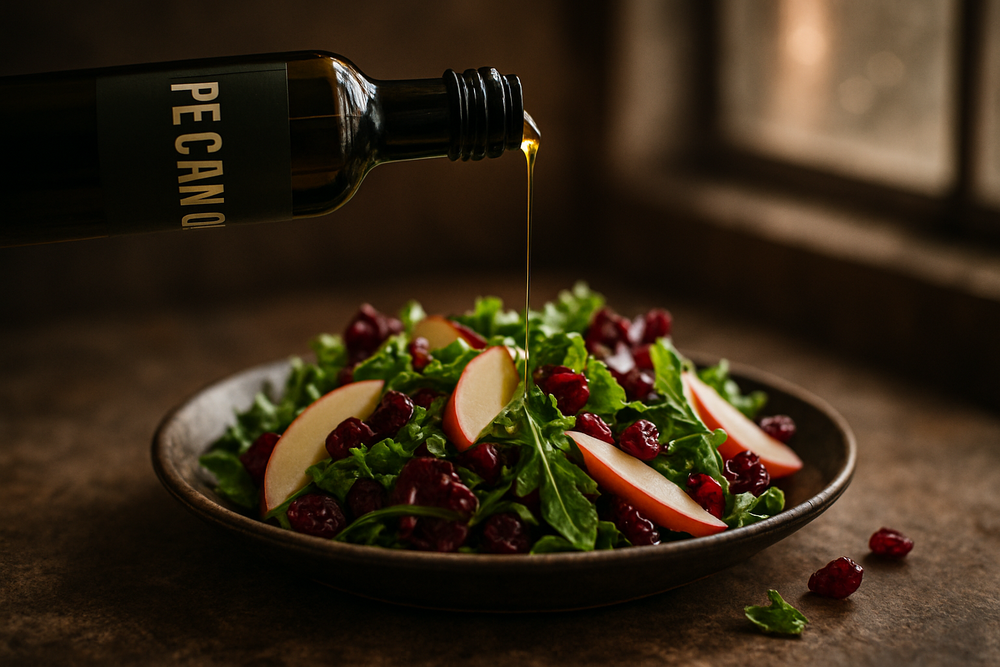
- Salad dressings: Whisk cold-pressed pecan oil with apple cider vinegar, a little Dijon mustard, and maple syrup for a Southern-inspired vinaigrette that pairs naturally with arugula, pears, and walnuts.
- High-heat sautéing: Use refined pecan oil for stir-frying vegetables or searing tofu — the high smoke point means less breakdown of the oil at cooking temperatures and less smoke in the kitchen.
- Baking swap: Substitute pecan oil 1:1 for melted butter in muffin or quick bread recipes for a lower-saturated-fat result with a subtle nutty background note.
Common pairings
- Pecan oil + sweet potato + smoked paprika: The oil's mild sweetness amplifies roasted sweet potato without dominating. Toss cubed sweet potato in a teaspoon of pecan oil and paprika before roasting at high heat.
- Pecan oil + bitter greens (radicchio, endive): The slight nuttiness softens bitterness in raw salads. A light drizzle with lemon juice balances well without extra ingredients.
- Pecan oil + dark chocolate in baking: Used in place of butter or neutral oil in brownie recipes, pecan oil adds a complementary flavor that makes the chocolate taste slightly richer.
Buying guide
Cold-pressed vs. refined:
- Look for "cold-pressed" or "expeller-pressed" on the label if you want minimal processing and more flavor. These terms indicate mechanical extraction rather than chemical solvent extraction.
- "Refined" or "high-heat" versions are fine for cooking but will have a more neutral flavor and longer shelf life.
Label tips:
- Ingredient list should read: "pecan oil" — nothing else. Avoid blends that dilute with cheaper oils unless you specifically want a blend.
- Check the harvest or best-before date. Nut oils go rancid faster than more stable oils like coconut or refined sunflower.
- Darker glass bottles offer better protection from light-induced oxidation than clear plastic.
Fresh vs. supplement:
- Pecan oil is not commonly available as a capsule supplement. Culinary-grade oil is the standard form. Be skeptical of highly concentrated "pecan oil supplements" making therapeutic claims, as these have no clinical evidence base.
Where to find it:
- Specialty grocery stores, Southern US regional markets, and online retailers carry pecan oil. It is less widely stocked than olive or avocado oil, but availability is growing.
Bottom line
Pecan oil is a genuinely decent cooking fat. Its fatty acid profile — high in monounsaturated oleic acid, moderate in omega-6 linoleic acid, low in saturated fat — is comparable to olive oil, and its very high smoke point (~470°F / 243°C) makes it one of the more practical options for high-heat cooking. Used in place of butter or cocon
How Pecan Oil Compares
| Compared with | What's different |
|---|---|
| Pecan Oil vs. Butter | Lower saturated fat (9-10%) than butter (50-55%) and a higher smoke point for searing. |
| Pecan Oil vs. Corn Oil | Contains significantly more heart-healthy monounsaturated fats (52%) than common corn oil. |
| Pecan Oil vs. Toasted Sesame Oil | Offers a milder, buttery nut flavor compared to the intense, toasted aroma of sesame oil. |
Health Benefits
Things to Know
Tree nut allergy: People with known pecan or tree nut allergies should approach pecan oil with caution. Refining reduces but may not eliminate allergenic proteins. If you have had a severe nut reaction, consult an allergist before trying any nut-derived oil.
Calorie density: At ~120 kcal per tablespoon, oils add calories fast. This is relevant for anyone managing weight or on a calorie-restricted plan. Portion awareness matters more with oils than with most other foods.
WFPB and very-low-fat diets: Strict WFPB protocols (like those used in some cardiovascular disease reversal programs) advise eliminating added oils entirely. If you follow this approach, pecan oil is not compliant — whole pecans are the recommended fat source instead.
Gallbladder disease / fat malabsorption / pancreatitis: Conditions that impair fat digestion may require individualized limits on total fat from any source, including plant oils. Get personalized guidance from a clinician.
Weight-loss medications (lipase inhibitors): Drugs that block fat absorption (e.g., orlistat) can cause more GI side effects when dietary fat intake is high. Large amounts of added oil may worsen this effect.
Medication absorption: High-fat meals can alter absorption timing for some oral medications. Follow your prescriber's guidance on whether to take medications with or without food.
Storage: Store in a cool, dark place; refrigerate after opening if possible. Discard if it smells rancid (sharp, crayon-like, or stale). Rancid oils contain oxidized fats that may be harmful with repeated consumption.
Pregnancy: No specific contraindications for typical culinary amounts. Standard advice to limit processed fats and prioritize whole foods applies.
Prep Ideas
- — Salad dressings: Whisk cold-pressed pecan oil with apple cider vinegar, a little Dijon mustard, and maple syrup for a Southern-inspired vinaigrette that pairs naturally with arugula, pears, and walnuts.
- — High-heat sautéing: Use refined pecan oil for stir-frying vegetables or searing tofu — the high smoke point means less breakdown of the oil at cooking temperatures and less smoke in the kitchen.
- — Baking swap: Substitute pecan oil 1:1 for melted butter in muffin or quick bread recipes for a lower-saturated-fat result with a subtle nutty background note.
- — Pecan oil + sweet potato + smoked paprika: The oil's mild sweetness amplifies roasted sweet potato without dominating. Toss cubed sweet potato in a teaspoon of pecan oil and paprika before roasting at high heat.
- — Pecan oil + bitter greens (radicchio, endive): The slight nuttiness softens bitterness in raw salads. A light drizzle with lemon juice balances well without extra ingredients.
- — Pecan oil + dark chocolate in baking: Used in place of butter or neutral oil in brownie recipes, pecan oil adds a complementary flavor that makes the chocolate taste slightly richer.
Shop This Ingredient
Stock your pantry with quality pecan oil.
Buy on AmazonAs an Amazon Associate, Plantopedia earns from qualifying purchases. This costs you nothing extra and helps us keep the encyclopedia free.
Frequently Asked Questions
Important framing note: There are no published human clinical trials specifically testing pecan oil as an intervention. The health claims below are extrapolated from (a) pecan oil's fatty acid profile, (b) large human studies on similar high-MUFA oils like olive oil, and (c) research on nut consumption broadly. Treat these as plausible, not proven. Heart and circulation Replacing saturated fats (butter, coconut oil, lard) with unsaturated plant oils is one of the most consistently supported strategies in cardiovascular nutrition. Because pecan oil's fat profile is dominated by oleic acid and linoleic acid — both unsaturated — it fits this pattern. Human studies on high-oleic diets show improvements in LDL cholesterol, LDL/HDL ratios, and blood vessel function. However, those studies mostly used olive oil or canola oil, not pecan oil specifically. The extrapolation is reasonable but not certain. For pecan oil vs butter: Swapping butter for pecan oil in baking or sautéing likely reduces your saturated fat load per serving, which research broadly supports for heart health. Digestive health and satiety Pecan oil has no fiber — unlike whole pecans, which provide about 10 g of fiber per 100 g. Dietary fat in general slows stomach emptying and can prolong feelings of fullness, but this is a general property of fat, not something unique to pecan oil. There are no clinical studies examining pecan oil specifically for digestive outcomes. Blood sugar and metabolism No clinical trials have tested pecan oil specifically on blood glucose or insulin sensitivity. Replacing refined carbohydrates or saturated fats with unsaturated fats can modestly improve post-meal blood sugar responses, but again, this evidence comes from broader dietary pattern studies. If blood sugar management is a primary concern, whole pecans (which slow glucose absorption via fiber and protein) have a stronger evidence base than the extracted oil. Inflammation and recovery Diets higher in unsaturated plant fats and lower in saturated fat are associated with lower markers of systemic inflammation (ongoing low-level immune activity throughout the body) in large observational studies. Pecan oil's fat profile is unlikely to promote inflammation when it replaces saturated fats. However, specific anti-inflammatory claims for pecan oil should be treated as early and theoretical, not clinically established.
Cold-pressed / virgin pecan oil Mechanically extracted without high heat. More flavor — mildly nutty and slightly sweet — and potentially better retention of minor antioxidant compounds. Best used as a finishing oil drizzled over food, in salad dressings, or for low-to-medium heat cooking. Higher price point; shorter shelf life. Refined / expeller-pressed pecan oil More heavily processed, giving it a neutral flavor and a very high smoke point (470°F / 243°C). Best for high-heat cooking — sautéing, stir-frying, roasting, or pan-frying — where flavor neutrality and heat stability matter. Longer shelf life. Less expensive. Cosmetic-grade pecan oil Used topically as a carrier oil in massage, skin care, and hair products. Not intended as a food source. Anecdotal claims about skin softening are plausible given its fat content, but robust clinical evidence for skin or hair benefits compared to other oils is limited. Quick rule of thumb: Cold-pressed for flavor and finishing; refined for heat. If you cannot find pecan oil, a high-quality extra-virgin olive oil makes a good cold-application substitute, and avocado oil or refined sunflower oil work well for high heat.
There are no established clinical dosing guidelines for pecan oil. General guidance from major dietary frameworks (USDA MyPlate, Harvard Healthy Eating Plate) suggests treating all added oils as a small, portion-controlled part of an overall diet rather than a supplement to take in specific amounts. Practical ranges: As a cooking fat: 1 teaspoon to 1 tablespoon per serving (5–14 g) is a typical range for sautéing one serving of vegetables or mixing a single-serve dressing. If managing calories: Keep total added oil (all sources) to 1–2 tablespoons per day maximum, and consider swapping some or all of that to whole nut or seed portions instead. Start low: If you are new to pecan oil or have a sensitive digestive system, introduce it in small amounts (½ teaspoon) to assess tolerance before using larger volumes. The "whole food first" principle: If your goal is cardiovascular health, weight management, or blood sugar control, a small handful of whole pecans (about 28 g / 1 oz) delivers the same healthy fats plus 3 g fiber, 3 g protein, and a broader micronutrient profile — with likely better satiety per calorie than the extracted oil.
Quick Answers
Common questions, answered in a line.
Pecan oil has a very high smoke point of approximately 470°F (243°C), making it a practical choice for high-heat cooking. Because it resists breaking down at high temperatures, it is ideal for stir-frying vegetables, searing tofu, and other sautéing methods.
Pecan oil contains roughly 9–10% saturated fat, which is significantly lower than butter, coconut oil, or lard. By comparison, butter is about 50–55% saturated fat, while coconut oil contains approximately 82%.
Pecan oil is primarily composed of oleic acid (an omega-9 monounsaturated fat) at 52% and linoleic acid (an essential omega-6 fatty acid) at about 36–37%. It also contains small amounts of vitamin E, which acts as a fat-soluble antioxidant.
Pecan oil can be used as a 1:1 substitute for melted butter in baking recipes like muffins or quick breads. This swap results in a lower-saturated-fat dish while providing a subtle, buttery, and nutty flavor profile.
Cold-pressed or expeller-pressed pecan oil is recommended if you want minimal processing and more flavor, as these methods avoid chemical solvents. Refined versions have a more neutral taste and a longer shelf life, making them suitable for high-heat applications.
People with tree nut allergies should approach pecan oil with caution because refining may not eliminate all allergenic proteins. Those with a history of severe reactions are advised to consult an allergist before consuming any nut-derived oil.
Pecan oil should be stored in a cool, dark place and refrigerated after opening to prevent it from going rancid. You should discard the oil if it develops a sharp, stale, or crayon-like smell, as rancid oils contain oxidized fats.
For Readers in the USA
Local context — sourcing, seasonality, and regional notes.
Pecan oil is primarily produced in the Southern United States, with Georgia, Texas, and New Mexico leading as the top pecan-growing states. These regions provide the ideal climate for the Carya illinoinensis tree, ensuring a steady domestic supply of the oil throughout the year.
Pecan oil is sold at specialty grocers like Whole Foods Market, regional Southern chains like H-E-B or Publix, and directly through American orchards at farmers markets. While not as ubiquitous as canola oil, it is increasingly available in the gourmet oil section of major U.S. supermarkets.
Check the label for the USDA Organic seal to ensure the pecans were grown without synthetic pesticides, as well as the "Product of USA" stamp to support domestic farmers. The FDA regulates pecan oil as a food product, requiring clear labeling of the common name to alert those with tree nut allergies.
In American cuisine, pecan oil is a staple of Southern "farm-to-table" cooking, often used to finish sweet potato dishes, dressings for Thanksgiving salads, or as a heart-healthy local alternative to butter in biscuits. Its buttery profile aligns perfectly with traditional U.S. comfort food flavors.
AI Clinical Review
- Accurately frames pecan oil as high in monounsaturated fat and low in saturated fat compared with butter and coconut oil, which aligns with evidence that replacing saturated fats with unsaturated plant oils supports healthier blood lipid profiles.
- Clearly distinguishes oil from whole nuts: pecan oil is calorie‑dense and nearly pure fat, while whole pecans add fiber, protein, and micronutrients that aid satiety and metabolic health.
- Practical guidance on forms and uses is sound: cold‑pressed/virgin for flavor and finishing; refined for high‑heat cooking due to a higher smoke point; plus sensible storage tips to prevent rancidity.
- Balanced dietary context: acknowledges that some whole‑food, plant‑based approaches minimize added oils and may favor whole nuts instead—useful for readers tailoring to different health goals.
- There are no human trials testing pecan oil itself as a health intervention. Benefits are inferred from its fatty acid profile and from studies of other high‑MUFA oils and nut consumption.
- High‑heat performance is often summarized by “smoke point,” but real‑world oxidation and by‑product formation also depend on refining, antioxidant content, and time at temperature—data specific to pecan oil are limited.
- Claims related to blood sugar, inflammation, or satiety are plausible but indirect; without fiber or protein, oil alone may be less satiating per calorie than whole nuts, and head‑to‑head clinical comparisons are sparse.
- The omega‑6 (linoleic acid) content is not inherently inflammatory at typical intakes, but pecan‑oil–specific research on inflammatory markers or omega‑3 balance is lacking.
- Tree‑nut allergy: refined oils may contain fewer proteins but are not risk‑free. Anyone with a history of severe reactions to pecans or tree nuts should avoid or seek allergist guidance before trying pecan oil.
- Portion guidance: for everyday cooking, 1 teaspoon to 1 tablespoon per serving is reasonable. If managing calories or lipids, consider keeping total added oils to about 1–2 tablespoons per day and using whole nuts for some of those fats.
- Medical considerations: people with gallbladder disease, fat malabsorption, pancreatitis, or those taking lipase inhibitors (e.g., orlistat) should discuss added oils with a clinician; high‑fat meals can also affect absorption timing of certain medications.
- Storage and freshness matter: buy smaller, dark‑glass bottles; keep cool and protected from light; refrigerate after opening if possible; discard if the oil smells sharp, crayon‑like, or stale (signs of rancidity).
Flag strict WFPB limitations for extracted oils and highly processed fat products.
References
- PubMed — Effects of supplementing a healthy diet with pecan nuts or extra-virgin olive oil on inflammatory profile of patients with stable coronary artery disease: a randomised clinical trial (pubmed.ncbi.nlm.nih.gov)
- PubMed — Effects of a healthy diet enriched or not with pecan nuts or extra-virgin olive oil on the lipid profile of patients with stable coronary artery disease: a randomised clinical trial (pubmed.ncbi.nlm.nih.gov)
- PubMed — The pecan nut (Carya illinoinensis) and its oil and polyphenolic fractions differentially modulate lipid metabolism and the antioxidant enzyme activities in rats fed high-fat diets (pubmed.ncbi.nlm.nih.gov)
- PMC, National Library of Medicine — Pecans and Human Health: Distinctive Benefits of an American Nut (pmc.ncbi.nlm.nih.gov)
- PMC, National Library of Medicine — A Pecan-Rich Diet Improves Cardiometabolic Risk Factors in Overweight and Obese Adults: A Randomized Controlled Trial (pmc.ncbi.nlm.nih.gov)
- PMC, National Library of Medicine — Comparison of Oil Content and Fatty Acids Profile of Western Schley, Wichita, and Native Pecan Nuts Cultured in Chihuahua, Mexico (pmc.ncbi.nlm.nih.gov)
- Wiley Online Library — Jhn.12727 (onlinelibrary.wiley.com)
- ScienceDirect — S0308814614011406 (sciencedirect.com)
- USDA FoodData Central — USDA FoodData Central (fdc.nal.usda.gov)
Know Your Numbers
Eating healthy is a start. Now get to know your biomarkers.
Food changes bloodwork — inflammation, lipids, blood sugar and nutrient status all respond to what you eat. 59 markers from $59.
- Results in 7–10 days at 2,000+ Quest sites
- Licensed provider reviews every result
- One flat price, no membership, HSA/FSA eligible
Educational information only, not medical advice. Panels are ordered and reviewed through our licensed partner; Plantopedia may earn a commission.