Apricot Kernel Oil — health benefits and uses
Used in traditional skincare; sweet culinary kernels prized in Central Asia.
The Short Answer
Culinary apricot kernel oil is safe to eat if labeled 'sweet' and food-grade; the refining process and use of sweet kernels ensure cyanide-releasing amygdalin is not present in dangerous amounts.

Apricot Kernel Oil · Photograph
Discover apricot kernel oil benefits and safety in one clear guide. Learn how this light, faintly almond-scented oil fits into cooking, baking, and skin care, what the research actually shows, and why choosing sweet culinary grade matters for avoiding cyanide risk.
Key Nutrients
% Daily Value based on 2,000 cal diet
Key active compounds
- Oleic acid (omega-9 monounsaturated fatty acid): Makes up roughly 50–60% of the oil's total fatty acids. A monounsaturated fat associated with improved blood lipid profiles when it replaces saturated fat in the diet. Also contributes to the oil's pleasant light texture and reasonable heat stability.
- Linoleic acid (omega-6 polyunsaturated fatty acid): Typically 15–35% of the oil. An essential fatty acid that supports normal skin barrier function and cell membrane integrity. Makes the oil fluid and quick-absorbing — useful in skin-care formulas.
- Tocopherols (vitamin E compounds): A family of fat-soluble antioxidants — compounds that help prevent cell damage from unstable molecules called free radicals. Present in small amounts; contribute modestly to antioxidant intake and help slow the oil's oxidation on the shelf.
- Phytosterols: Plant sterol compounds structurally similar to cholesterol. Found at low to moderate levels in most seed oils. May help slightly reduce intestinal cholesterol absorption in sufficient quantities; current evidence for apricot kernel oil specifically is mostly compositional rather than clinical.
- Palmitic and stearic acids (minor saturated fats): Small proportions that round out the fatty acid profile and influence the oil's stability.
Is apricot kernel oil safe to eat? Sweet vs bitter forms explained
This is the most important safety question for this ingredient, so it gets its own section.
Sweet apricot kernel oil (culinary grade): Pressed from sweet-kernel apricot varieties. Amygdalin — a naturally occurring cyanogenic glycoside (a plant compound that can release cyanide when broken down in the body) — is water-soluble and does not readily move into the oil phase. Properly processed culinary-grade oil therefore contains only trace amounts, and food-safety assessments by regulators in Australia, New Zealand, and the UK conclude that the cyanide risk from the oil itself is negligible. This is the grade to look for when cooking.
Bitter apricot kernels and bitter-kernel extracts: Bitter variety kernels naturally contain much higher amygdalin. Eating raw bitter kernels — particularly in quantities promoted by some alternative-health websites — has caused real cyanide poisoning cases, including deaths. Symptoms range from nausea, headache, and dizziness to respiratory failure at high doses. Multiple national food-safety authorities restrict or warn against their sale for direct consumption.
Laetrile / "vitamin B17" supplements: These products are based on concentrated amygdalin or whole kernel preparations — not culinary oil. Major medical organisations state they are not effective for cancer and can cause serious cyanide toxicity. They are a categorically different product from culinary apricot kernel oil.
Bottom line on safety: If the label says culinary sweet apricot kernel oil and it is produced to food-grade standards, the cyanide risk is not a meaningful concern. If a product is labelled bitter kernel oil, laetrile, or "vitamin B17," do not treat it as interchangeable.
Prep and pairing ideas
In the kitchen:
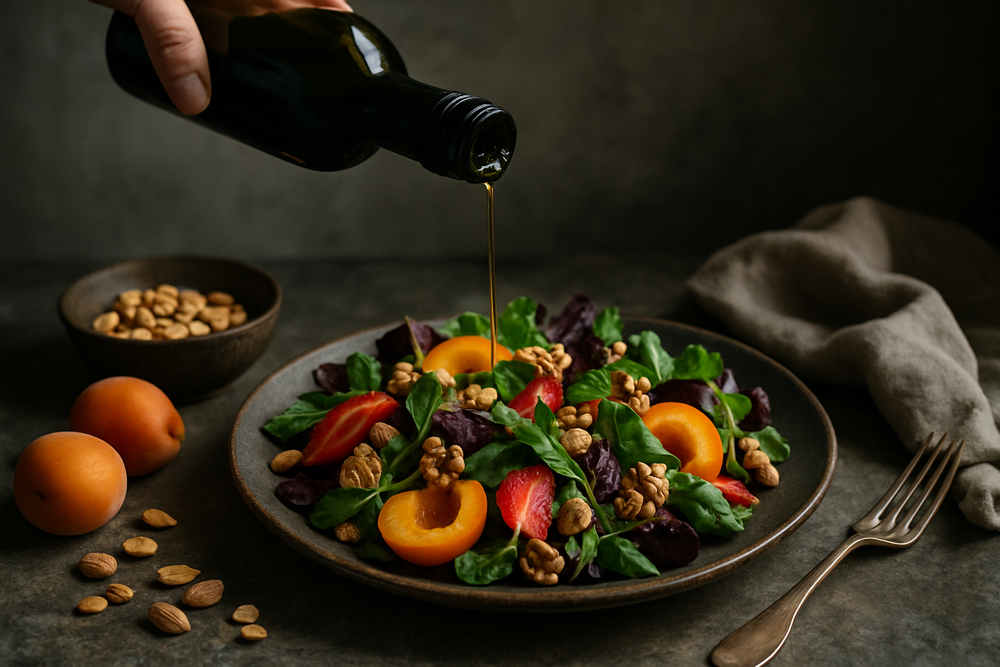
- Apricot kernel oil + lemon zest + fresh herbs → light salad dressing. The oil's mild almond undertone works especially well with tarragon, basil, or chervil. Whisk 2 tablespoons of oil with 1 tablespoon of lemon juice and a pinch of salt for an elegant vinaigrette.
- Apricot kernel oil in almond cake or financiers. Swap melted butter or neutral vegetable oil 1:1. The oil's natural affinity with stone-fruit flavours deepens the almond profile without adding more nut flour.
- Finishing drizzle over roasted stone fruits or yoghurt. A teaspoon over oven-roasted peaches or nectarines with a crack of black pepper makes an easy dessert or breakfast. Add after cooking to preserve the delicate aroma.
For skin and hair:
- Apply 4–6 drops to clean, damp skin as a facial moisturiser — the dampness helps the oil absorb evenly.
- Use as a carrier oil for diluting essential oils (a maximum of 2–3% essential oil is a common guideline for facial use).
- Warm a small amount between palms and smooth over the ends of dry hair before styling.
Bottom line
Apricot kernel oil is a genuinely versatile ingredient — light enough for delicate baking, neutral enough for vinaigrettes, and absorbent enough for skin care — with a fatty acid profile anchored by oleic acid and supported by linoleic acid and small amounts of vitamin E. The science behind its specific health effects in humans is still thin; most of the interesting findings sit in animal and cell studies rather than clinical trials. Think of it as one more good unsaturated plant oil rather than a functional supplement.
The safety picture is straightforward once you understand the grade distinction: culinary sweet apricot kernel oil poses no meaningful cyanide risk. Whole bitter kernels, kernel powder, and laetrile products are an entirely different matter and carry real documented risks. Buy culinary grade, enjoy it the same way you would almond or light olive oil, and skip the bitter-kernel health claims entirely.
If you want to explore how apricot kernel oil fits into a broader food-as-medicine eating pattern, browse Plantopedia's goals pages for context-specific guidance.
How Apricot Kernel Oil Compares
| Compared with | What's different |
|---|---|
| Apricot Kernel Oil vs. Sweet Almond Oil | Stronger nutty flavor and lower smoke point, often used as a finishing oil rather than for cooking. |
| Apricot Kernel Oil vs. Avocado Oil | Higher smoke point (270°C) and neutral flavor, whereas apricot oil has a faint almond scent. |
| Apricot Kernel Oil vs. Extra Virgin Olive Oil | Significantly higher vitamin E content (14.9mg vs 0.54mg per tbsp) and a distinct peppery taste. |
Health Benefits
Things to Know
Choose the right grade.: Only use culinary sweet apricot kernel oil for cooking and eating. Do not substitute bitter kernel preparations.
Stone-fruit and tree-nut allergies.: Apricot belongs to the Prunus genus alongside almond, peach, and cherry. People with known allergy to any of these should exercise caution with apricot kernel oil — particularly in topical products where protein traces may be present.
Pregnancy and breastfeeding.: Culinary amounts of properly processed sweet apricot kernel oil are unlikely to pose a cyanide risk, but it has not been specifically studied in pregnancy or lactation. Apricot kernels and laetrile products should be avoided entirely during pregnancy.
Children.: Children are at higher risk of severe outcomes from cyanide exposure than adults. Do not give raw apricot kernels or bitter-kernel products to children.
Liver or kidney conditions.: These organs help neutralise cyanide. People with impaired liver or kidney function may be more vulnerable to cyanide toxicity from kernel-based (non-oil) preparations.
Cancer treatment.: Laetrile and apricot-kernel-based "natural cancer remedies" are not safe or effective alternatives to evidence-based oncology care. If a healthcare provider has not recommended them, do not add them.
Calorie density.: Like all oils, apricot kernel oil provides about 120 calories per tablespoon. Generous daily use can add up quickly if you are managing weight or calorie intake.
Drug interactions.: No clinically important drug interactions are documented for normal culinary or cosmetic use of food-grade sweet apricot kernel oil. Interactions involving cyanide toxicity relate specifically to whole kernel or laetrile products, not the refined culinary oil.
Prep Ideas
- — **Apricot kernel oil + lemon zest + fresh herbs → light salad dressing.** The oil's mild almond undertone works especially well with tarragon, basil, or chervil. Whisk 2 tablespoons of oil with 1 tablespoon of lemon juice and a pinch of salt for an elegant vinaigrette.
- — **Apricot kernel oil in almond cake or financiers.** Swap melted butter or neutral vegetable oil 1:1. The oil's natural affinity with stone-fruit flavours deepens the almond profile without adding more nut flour.
- — **Finishing drizzle over roasted stone fruits or yoghurt.** A teaspoon over oven-roasted peaches or nectarines with a crack of black pepper makes an easy dessert or breakfast. Add after cooking to preserve the delicate aroma.
- — Apply 4–6 drops to clean, damp skin as a facial moisturiser — the dampness helps the oil absorb evenly.
- — Use as a carrier oil for diluting essential oils (a maximum of 2–3% essential oil is a common guideline for facial use).
- — Warm a small amount between palms and smooth over the ends of dry hair before styling.
Shop This Ingredient
Stock your pantry with quality apricot kernel oil.
Buy on AmazonAs an Amazon Associate, Plantopedia earns from qualifying purchases. This costs you nothing extra and helps us keep the encyclopedia free.
Frequently Asked Questions
Most research on apricot kernel oil comes from laboratory and animal studies, not large human trials. That distinction matters — it means the biological mechanisms look plausible, but we cannot yet say with confidence that a daily tablespoon will produce measurable health outcomes in people. Here is what the current evidence suggests. Heart health and circulation Apricot kernel oil's high oleic acid content is its strongest cardiovascular calling card. Diets that swap saturated fats for monounsaturated-rich oils like this one are broadly associated with better blood lipid profiles in human dietary research. No well-controlled trial has tested apricot kernel oil as a standalone intervention for cholesterol or blood pressure, so any benefit is inferred from its fatty acid profile and the wider evidence base for unsaturated plant oils. In animal models, however, apricot kernel oil has shown protective effects on heart tissue under conditions of experimentally induced injury — encouraging preclinical findings that need human follow-up. Digestive health and microbiome At typical culinary amounts, apricot kernel oil behaves like other neutral vegetable oils in the digestive tract — it contributes calories and fat without fibre or fermentable compounds. In vitro (test-tube) experiments suggest that apricot fruit and seed extracts may reduce cholesterol gallstone formation, but these have not been tested in people. As a refined fat, it should be used in moderation within your overall calorie needs, particularly if you have gallbladder issues or a fat-malabsorption condition. Blood sugar and metabolism There is no direct human evidence that apricot kernel oil improves blood glucose, insulin sensitivity, or diabetes outcomes. Preclinical work has focused more on lipid metabolism than glucose control. People with diabetes can use it as they would other plant oils, staying mindful that all fats are calorie-dense and need to fit within an individualised meal plan. Inflammation and recovery Animal and cell studies report that apricot kernel oil and related seed extracts reduce markers of oxidative stress (cell damage from free radicals) and inflammation. One rat study found that the oil reduced pain hypersensitivity in a neuropathic pain model. These results support biological plausibility but cannot be assumed to translate directly to human chronic pain or inflammatory conditions without clinical trial evidence. Skin health (topical use) For external use, the evidence is stronger through practical application than clinical trial. Apricot kernel oil's combination of oleic and linoleic acids supports skin barrier function, and its light texture absorbs quickly without leaving a heavy residue — qualities that make it well tolerated on the face, body, and scalp. Controlled head-to-head trials against other plant oils for conditions like eczema or skin ageing are scarce; benefits are currently inferred from fatty acid composition and widespread traditional use.
The flavour-conscious home baker Needs a neutral plant-based fat that won't overpower delicate cakes, muffins, or pastry. Wants a one-to-one swap for vegetable oil in recipes without changing the final taste profile. Appreciates a slightly elevated ingredient with a subtle almond note for specialty baking projects. The skin-care minimalist Looks for a lightweight, fast-absorbing facial or body oil that can double as a makeup-removal oil. Has dry or maturing skin and wants linoleic acid support for barrier repair without greasy residue. Prefers a single multitasking oil that works as a hair serum, massage base, and moisturiser in one.
| Use case | Recommended form | Notes | | --- | --- | --- | | Delicate baking (cakes, muffins) | Cold-pressed sweet culinary grade | Subtle almond note enhances rather than competes | | Salad dressings and vinaigrettes | Cold-pressed sweet culinary grade | Light body emulsifies well; flavour stays fresh | | Light sautéing and stir-frying | Lightly refined sweet grade | Higher smoke point than unrefined; neutral flavour | | Finishing drizzle | Cold-pressed sweet culinary grade | Delicate aroma comes through best added after cooking | | Skin, hair, and massage | Cosmetic-grade cold-pressed | Not intended for ingestion; may contain additives unsuitable for cooking | | Avoid entirely | Bitter kernel oil, laetrile | Cyanide risk; not a culinary product | Cold-pressed oils retain more of their natural tocopherols and aroma compounds. Refined versions have a slightly higher smoke point (the temperature at which an oil begins to burn and smoke) and a longer shelf life, making them practical for everyday cooking. The smoke point of apricot kernel oil is approximately 215–220 °C (420–430 °F), which is suitable for light to medium-heat cooking but not deep-frying.
No evidence-based therapeutic dose has been established for apricot kernel oil because the human clinical trial data are limited. For everyday culinary use, the practical guidance is the same as for any unsaturated plant oil: 1–2 tablespoons (15–30 mL) per day spread across meals is a reasonable range for most adults following general healthy-eating guidelines. This fits the broader recommendation that dietary fat should account for roughly 20–35% of total calories, with most of that coming from unsaturated sources. If you are already using olive oil, avocado oil, or another plant oil generously, replacing rather than adding is usually the smarter move. Start low if you are introducing it for the first time — as with any new food, individual digestive tolerance varies. For topical use, amounts depend on the product formulation; it is commonly used as 5–100% of the oil phase in cosmetic preparations with no specific upper safety limit established for healthy skin.
Quick Answers
Common questions, answered in a line.
Culinary sweet apricot kernel oil is safe to eat because the cyanide-releasing compound amygdalin is water-soluble and does not readily move into the oil during processing. Food safety regulators in the UK, Australia, and New Zealand consider the cyanide risk from this oil negligible.
Apricot kernel oil contains high levels of oleic acid (omega-9), linoleic acid (omega-6), vitamin E tocopherols, and phytosterols. Oleic acid makes up 50–60% of the fatty acids, while linoleic acid provides 15–35%, supporting both heart health and skin barrier function.
Sweet apricot kernel oil is a safe, culinary-grade product, whereas bitter apricot kernels contain high levels of amygdalin that can cause fatal cyanide poisoning. You should only use the sweet variety for cooking and avoid bitter kernel extracts or "vitamin B17" supplements.
You can use apricot kernel oil as a light salad dressing, a 1:1 substitute for butter in almond cakes, or as a finishing drizzle over roasted stone fruits. Its mild almond undertone pairs particularly well with herbs like tarragon and basil or fresh lemon zest.
Apricot kernel oil works as a facial moisturizer, a hair treatment for dry ends, or a carrier oil for diluting essential oils. Because it contains linoleic acid, it is quick-absorbing and supports the skin's natural barrier function.
People with allergies to stone fruits or tree nuts, such as almonds, peaches, or cherries, should exercise caution with apricot kernel oil. Additionally, children and pregnant women should strictly avoid bitter kernels and laetrile due to the high risk of cyanide toxicity.
For Readers in the USA
Local context — sourcing, seasonality, and regional notes.
You can find culinary-grade apricot kernel oil at major U.S. retailers like Whole Foods Market, Sprouts Farmers Market, and through online specialty vendors like Amazon or Thrive Market. Look for "Sweet" or "Culinary" labels in the specialty oil or natural beauty aisles.
The FDA does not recognize "Vitamin B17" as a vitamin and has banned the interstate sale of Laetrile due to its potential for cyanide poisoning and lack of proven medical benefit. Culinary apricot kernel oil, however, is legal when sold as a food-grade vegetable oil.
In the U.S., most apricot kernels are sourced from California, which produces about 90% of the nation's apricots, typically harvested between May and August. While the fruit is seasonal, the shelf-stable oil is available year-round across all 50 states.
To ensure the highest quality in the U.S., look for the USDA Organic seal and labels indicating "Cold-Pressed" and "Non-GMO Project Verified." These certifications help confirm the oil was extracted without high heat or harsh chemical solvents like hexane.
AI Clinical Review
- The oil’s fatty‑acid profile is accurately described: mostly oleic acid with meaningful linoleic acid, comparable to almond/peach kernel oils, which supports using it in place of saturated fats.
- Calorie density and micronutrient content are framed realistically (about 120 kcal per tablespoon; small, not supplemental, amounts of vitamin E).
- The safety distinction between culinary sweet-kernel oil vs. bitter kernels/laetrile is clear and clinically important; cyanide risk is tied to kernels/extracts, not properly produced culinary oil.
- Practical guidance matches real‑world use: a light, neutral oil suited to baking, dressings, and light sautéing; topical use is reasonable given its texture and barrier‑supporting fatty acids.
- Human trials testing apricot kernel oil directly for heart, metabolic, or inflammatory outcomes are scarce; most benefits are inferred from general unsaturated‑fat research and preclinical studies.
- Digestive or gallstone claims are based on extracts and lab/animal data, not clinical trials with the culinary oil.
- Comparative advantages over olive or avocado oil (e.g., lipids, glycemia, skin outcomes) haven’t been established in head‑to‑head human studies; vitamin E content is too low to treat deficiency.
- Use like other plant oils: 1–2 tablespoons per day is a practical range if replacing—not adding to—other fats to manage calories.
- For eating, choose clearly labeled culinary sweet apricot kernel oil; avoid bitter kernels and “laetrile/B17” products entirely. Cosmetic‑grade oils may contain additives and aren’t for cooking.
- People with stone‑fruit or tree‑nut allergies should exercise caution (trace proteins may remain), and patch‑testing is prudent for topical use.
- Extra caution for pregnancy/lactation, young children, and those with liver or kidney disease—culinary oil in normal amounts is generally acceptable, but kernel‑based supplements pose cyanide risk and should be avoided.
Use sweet-kernel culinary grade only; bitter-kernel forms contain amygdalin (cyanide risk).
References
- USDA FoodData Central — oil, apricot kernel, nutritional composition (batchbase.com.au)
- University Hospitals nutrition facts for apricot kernel oil (USDA-based) (uhhospitals.org)
- Comprehensive review: Apricot Kernel Bioactivity, Characterisation, and Potential Health Benefits — PMC9332734 (pmc.ncbi.nlm.nih.gov)
- Anticancer Potential and Other Pharmacological Properties of Apricot Kernels and Kernel Oil — PMC9325146 (pmc.ncbi.nlm.nih.gov)
- Animal study: Cardioprotective effects of apricot kernel oil in experimental myocardial injury — PubMed 21896302 (pubmed.ncbi.nlm.nih.gov)
- Animal study: Analgesic effect of apricot kernel oil in neuropathic pain model — PMC11336353 (pmc.ncbi.nlm.nih.gov)
- 2024 review: Therapeutic and antimicrobial potential of bitter apricot kernel oil — PMC11563713 (pmc.ncbi.nlm.nih.gov)
- UK Government public health guidance on plant toxins and apricot kernels (gov.uk)
- Food Standards Australia New Zealand — Hydrocyanic Acid in Apricot Kernels and Other Foods (regulatory risk assessment) (oia.pmc.gov.au)
- WebMD consumer monograph — Apricot Kernel: Uses, Side Effects, and More (webmd.com)
Know Your Numbers
Eating healthy is a start. Now get to know your biomarkers.
Food changes bloodwork — inflammation, lipids, blood sugar and nutrient status all respond to what you eat. 59 markers from $59.
- Results in 7–10 days at 2,000+ Quest sites
- Licensed provider reviews every result
- One flat price, no membership, HSA/FSA eligible
Educational information only, not medical advice. Panels are ordered and reviewed through our licensed partner; Plantopedia may earn a commission.