Cocoyam — health benefits and uses
A dietary cornerstone in Nigerian and Ghanaian cooking, often pounded into fufu.
The Short Answer
Cocoyam is a nutrient-dense root vegetable providing 5.1g of fiber and 484mg of potassium per cup. It must be thoroughly boiled or cooked to neutralize calcium oxalate crystals, which cause throat irritation if eaten raw.

Cocoyam · Photograph
Discover cocoyam health benefits and side effects, including its impact on digestion, blood sugar, heart health, and more. Learn how to cook cocoyam safely, what the nutrition facts look like per 100 g, and who should be cautious — all backed by current evidence.
Key Nutrients
% Daily Value based on 2,000 cal diet
Key active compounds in cocoyam
- Resistant starch and non-digestible polysaccharides — Fractions of starch that pass through the small intestine undigested and reach the colon, where gut bacteria ferment them into short-chain fatty acids (compounds linked to gut lining health and metabolic regulation).
- Dietary fibre (cellulose, hemicellulose, pectins) — Non-starch plant cell wall materials that promote bowel regularity, increase stool bulk, and may help moderate post-meal blood glucose and cholesterol levels.
- Oxalates (calcium oxalate raphides) — Needle-like crystals found in raw cocoyam that cause oral and throat irritation; substantially reduced by thorough boiling or other traditional cooking methods. An antinutrient (a substance that interferes with nutrient absorption or causes harm) at high levels.
- Phytates (phytic acid) — Phosphorus-containing compounds in the corm that can bind minerals like iron and zinc, reducing their absorption. Soaking and boiling lower phytate levels considerably.
- Tannins and phenolic compounds — Small amounts of polyphenols (plant defence chemicals) that contribute modest antioxidant activity; levels in cooked cocoyam are generally low enough that absorption interference is not a significant concern.
- Vitamin E (tocopherols) — A fat-soluble antioxidant (a molecule that helps protect cells from oxidative damage caused by free radicals) present at notably higher levels than many other starchy roots.
Prep and pairing ideas
Cocoyam is remarkably adaptable, and cooking it well is straightforward once you know the basics.
Basic boiled cocoyam: Peel, cube into even pieces, cover with cold water, bring to a boil, and cook for 20–30 minutes until a fork passes through without resistance. Drain and eat as a side, or mash with a little olive oil and seasoning.
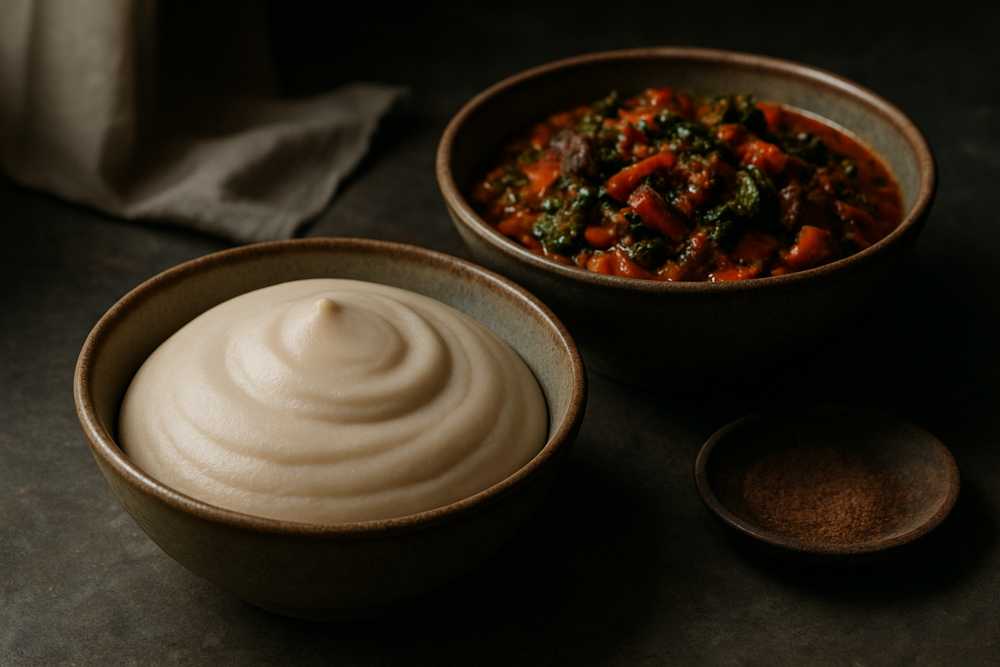
Fufu: Boil until very soft, drain well, and pound with a mortar and pestle (or blend briefly with a stand mixer) until smooth and elastic. Serve with egusi soup, groundnut soup, or any vegetable-rich stew.
Cocoyam porridge: Boil chunks with onion, tomatoes, palm oil (or olive oil), leafy greens, and smoked fish or legumes. This is a complete one-pot meal common across Nigeria and Ghana.
Common pairings that work well:
- Cocoyam + leafy greens (spinach, bitter leaf, or kontomire/cocoyam leaves): Leafy greens add iron, calcium, and folate, and their vitamin C boosts absorption of cocoyam's non-haem iron. A nutritional pairing with real logic behind it.
- Cocoyam + legumes (black-eyed peas, lentils, or groundnut soup): Legumes supply the protein and lysine that cocoyam lacks. Together they create a more balanced amino acid profile — the same principle behind traditional fufu-and-soup combinations.
- Cocoyam + a source of healthy fat (small amount of palm oil, olive oil, or avocado): Vitamin E in cocoyam is fat-soluble, meaning a small amount of fat in the same meal helps your body absorb it more efficiently.
Bottom line
Cocoyam is a genuinely nourishing whole plant food that earns its place as a complex-carbohydrate staple. It delivers meaningful fibre, potassium, vitamin B6, vitamin E, and resistant starch in a naturally gluten-free, very low-fat package. The evidence for specific health outcomes — lower blood pressure, better gut health, improved blood sugar — is mostly inferential or based on composition data rather than long-term clinical trials, so the language of "may support" is more honest than "prevents."
The two most important practical rules are: always cook it thoroughly (boiling is best), and choose boiled over roasted or fried if blood sugar matters to you. Used as part of a varied, whole-food diet alongside vegetables, legumes, and lean protein, cocoyam is a solid, time-tested carbohydrate choice.
Looking for other ingredients that support similar health goals? Explore our digestive health ingredient guides and complex-carb goal pages.
How Cocoyam Compares
| Compared with | What's different |
|---|---|
| Cocoyam vs. Taro | Taro is generally creamier when cooked, while cocoyam (malanga) holds its shape better in stews. |
| Cocoyam vs. Potato | Cocoyam contains nearly 3g of Vitamin E per cup, significantly higher than most white potatoes. |
Health Benefits
Things to Know
Always cook thoroughly.: Raw cocoyam contains calcium oxalate raphides that cause intense burning, swelling, and irritation of the mouth and throat. Boiling for at least 20–30 minutes until fully tender is the standard safe preparation.
Kidney stone history.: People with a history of calcium oxalate kidney stones (the most common type) or a condition called hyperoxaluria (abnormally high oxalate in urine) should be cautious, as cocoyam — even cooked — retains some oxalate. Speak to a dietitian before making it a regular part of your diet.
Chronic kidney disease (CKD).: Cocoyam provides several hundred milligrams of potassium per serving. People on potassium-restricted diets (common in CKD) should track intake carefully and consult their care team.
Diabetes and prediabetes.: Avoid roasted or fried cocoyam forms, favour boiled preparations, and start with modest portions (100–150 g cooked). Monitor your own post-meal blood glucose to understand your personal response.
Potassium-raising medications.: ACE inhibitors, angiotensin receptor blockers (ARBs), and potassium-sparing diuretics all raise blood potassium levels. Adding a high-potassium food like cocoyam on top of these medications may push potassium higher than intended. Mention this to your prescriber or pharmacist.
Blood glucose medications.: High-GI cocoyam preparations (roasted, fried) can cause rapid post-meal glucose rises that may interact with insulin or sulfonylurea timing.
Mineral supplements.: Residual phytates and oxalates in cocoyam can modestly reduce iron, zinc, and calcium absorption. Standard cooked servings are unlikely to cause clinically significant problems, but if you take mineral supplements, take them a couple of hours apart from a large cocoyam meal as a precaution.
Children.: Young children may be more sensitive to inadequately cooked cocoyam's oxalate content. Ensure full cooking and start with smaller portions.
Pregnancy.: Cooked cocoyam is generally considered safe as a food during pregnancy. The folate content (5% DV per 100 g) is a modest contributor to the increased folate needs of early pregnancy. No specific contraindications are established, but as with all dietary changes during pregnancy, discuss with your midwife or doctor.
Prep Ideas
- — Cocoyam + leafy greens (spinach, bitter leaf, or kontomire/cocoyam leaves): Leafy greens add iron, calcium, and folate, and their vitamin C boosts absorption of cocoyam's non-haem iron. A nutritional pairing with real logic behind it.
- — Cocoyam + legumes (black-eyed peas, lentils, or groundnut soup): Legumes supply the protein and lysine that cocoyam lacks. Together they create a more balanced amino acid profile — the same principle behind traditional fufu-and-soup combinations.
- — Cocoyam + a source of healthy fat (small amount of palm oil, olive oil, or avocado): Vitamin E in cocoyam is fat-soluble, meaning a small amount of fat in the same meal helps your body absorb it more efficiently.
Glossary
Shop This Ingredient
Stock your pantry with quality cocoyam.
Buy on AmazonAs an Amazon Associate, Plantopedia earns from qualifying purchases. This costs you nothing extra and helps us keep the encyclopedia free.
Frequently Asked Questions
The sections below cover the four areas where nutrition science gives us the clearest (if still emerging) picture. Heart health and blood pressure support Cocoyam provides around 484 mg of potassium per 100 g cooked — roughly 10% of the recommended daily intake in a single serving. Potassium is the key mineral that counterbalances sodium's effect on blood pressure. Adequate potassium intake is consistently associated with lower blood pressure and reduced cardiovascular risk in large population studies. Cocoyam also supplies magnesium (important for vascular tone and normal heart rhythm), is naturally very low in sodium, and contains no cholesterol or saturated fat. It would be misleading, however, to say cocoyam "prevents heart disease." No clinical trial has directly tested cocoyam intake against cardiovascular outcomes. The link is inferential: its mineral and fibre profile aligns with dietary patterns known to be cardioprotective. That is meaningful and worth knowing, but it is not the same as proven cause and effect. Cocoyam benefits for digestion and gut health At about 5 g of dietary fibre per 100 g cooked, cocoyam delivers more fibre per serving than white rice, white bread, or boiled cassava. Dietary fibre supports bowel regularity, increases stool bulk, and feeds the beneficial bacteria that live in the large intestine. The resistant starch fractions in cocoyam act as a prebiotic (food for gut bacteria), and the short-chain fatty acids those bacteria produce are linked to a healthier gut lining and lower levels of intestinal inflammation. Again, there are no published clinical trials measuring stool frequency or microbiome composition specifically after cocoyam consumption. The digestive support claim is grounded in its fibre and resistant starch content and well-established general fibre science — not cocoyam-specific intervention data. Traditional populations who eat boiled or pounded cocoyam daily appear to tolerate it well, which is observational but at least reassuring. Cocoyam benefits for diabetics and blood sugar management This is where the evidence gets most specific — and most nuanced. A glycaemic index (GI) study testing different cocoyam cultivars prepared in different ways found GI values ranging from as low as 19 (boiled "coco-India" variety) to as high as 142 (roasted pink cocoyam). GI is a measure of how quickly a food raises blood glucose compared to pure glucose. The headline finding: boiling tends to produce low-to-moderate GI values, while roasting and frying can produce high GI values, depending heavily on the cultivar. This means the same ingredient can behave very differently depending on how you cook it. For anyone managing blood sugar — including people with type 2 diabetes or prediabetes — boiled cocoyam in controlled portions appears to be a more cautious choice than roasted or fried forms. Individual responses still vary, so monitoring your own post-meal glucose is the most reliable guide. Inflammation and antioxidant activity Cocoyam provides vitamin E (2.93 mg/100 g, 20% DV) and some vitamin C (5 mg/100 g). Both are antioxidant vitamins that help the body manage oxidative stress — a state of cellular imbalance linked to chronic inflammation. Vitamin E in particular is present at levels higher than many other root vegetables, which is worth noting. That said, no human trial has measured inflammatory markers such as C-reactive protein (a blood marker of inflammation) in people eating cocoyam. Claims that cocoyam is "anti-inflammatory" are extrapolated from its vitamin profile and general antioxidant research. Treat them as plausible but unproven for now.
Boiling is the gold standard for both safety and blood sugar management. Boiling thoroughly degrades calcium oxalate crystals (making the corm safe to eat), reduces phytate and oxalate levels more effectively than dry-heat methods, and is associated with the lowest glycaemic index values across cultivars studied. Pounding into fufu (the traditional West African dough made from boiled cocoyam) retains a similar nutritional profile to plain boiled corm — the main practical difference is that fufu portions tend to be larger, so total carbohydrate and calorie intake can be higher than it appears. Cocoyam flour (dried and milled corm) is convenient for porridges and reconstituted fufu. Commercial flours may have slightly different nutrient profiles depending on drying temperature and processing, but are generally a reasonable option. Check labels for added starches or preservatives. Roasting develops a rich, nutty flavour but has been associated with higher GI values in some cultivars — a meaningful consideration if you are managing blood glucose. Frying (chips, slices, batter-fried pieces) adds significant fat and calories and tends toward moderate-to-high GI. Fried cocoyam snacks are fine occasionally, but are not the form to rely on if you are eating cocoyam for its health properties. One rule applies to all forms: never eat cocoyam raw or undercooked. If the corm causes any tingling or burning in your mouth after eating, it was not cooked long enough.
There is no official recommended daily dose for cocoyam specifically. In traditional West and Central African diets, portions of roughly 100–300 g of cooked corm per meal are common, providing approximately 140–425 calories depending on serving size and preparation. Glycaemic index research has used 50 g of available carbohydrate as a standardised test portion, which equates to roughly 140–170 g of cooked cocoyam. Practical starting guidance: If cocoyam is new to you, start with a 100 g cooked portion (about ½ cup mashed or 4–5 small chunks) to assess tolerance. For blood sugar management, keep portions at 100–150 g cooked boiled cocoyam per meal and pair with fibre, protein, or fat to further moderate glucose response. For everyday eating as a staple carbohydrate, 150–250 g per meal is a reasonable range for most adults with normal kidney function, balanced against the rest of your diet. If you are managing kidney disease, potassium restriction, or blood sugar with medication, get personalised portion guidance from a registered dietitian rather than using general ranges.
Quick Answers
Common questions, answered in a line.
You must always cook cocoyam thoroughly, typically by boiling for 20–30 minutes, to neutralize needle-like calcium oxalate crystals. These crystals, called raphides, are found in raw cocoyam and cause intense burning, swelling, and irritation in the mouth and throat.
Cocoyam contains resistant starch and dietary fiber, which pass undigested to the colon where they are fermented by gut bacteria into short-chain fatty acids. These compounds are linked to improved metabolic regulation and the overall health of the gut lining.
People with a history of calcium oxalate kidney stones or hyperoxaluria should be cautious because cocoyam retains some oxalate even after it is cooked. It is recommended that individuals with these conditions consult a dietitian before making cocoyam a regular part of their diet.
Cocoyam is a rich source of Vitamin E, a fat-soluble antioxidant that helps protect your cells from oxidative damage caused by free radicals. Its Vitamin E levels are notably higher than many other common starchy root vegetables.
To maximize nutrition, pair cocoyam with leafy greens to boost iron absorption via Vitamin C, or with legumes like lentils to create a complete amino acid profile. Adding a small amount of healthy fat, such as olive oil or avocado, also helps your body absorb the fat-soluble Vitamin E.
Individuals with diabetes should choose boiled cocoyam over roasted or fried versions and limit portions to 100–150g to manage blood glucose levels. Boiling helps maintain a lower glycemic impact compared to high-heat cooking methods that can cause rapid post-meal sugar rises.
For Readers in the USA
Local context — sourcing, seasonality, and regional notes.
In the United States, you can find cocoyam (often labeled as taro or malanga) at H-Mart, 99 Ranch Market, and local African, Caribbean, or Hispanic grocery stores. Large chains like Whole Foods or Wegmans occasionally carry them in the specialty produce section, particularly in metropolitan areas with diverse populations.
While most cocoyam is imported, it is commercially grown on a small scale in Hawaii and parts of Florida, where the warm, humid climate mimics its native tropical environment. Because it requires a long, frost-free growing season, it is rarely cultivated in northern U.S. states outside of private greenhouses.
In U.S. markets, cocoyam is frequently sold under regional names such as Malanga (popular in Florida and among Hispanic communities), Taro (common in Asian markets), or Eddo. While these varieties belong to the Araceae family and share similar nutritional profiles, their texture and size can vary slightly by region of origin.
The USDA does not have specific grading standards for cocoyam, but the FDA requires that it be sold in its raw form with clear country-of-origin labeling. If you are looking for organic options, look for the 'USDA Organic' seal, which ensures the root was grown without prohibited synthetic fertilizers or pesticides.
AI Clinical Review
- Emphasizes safety: raw cocoyam contains calcium oxalate crystals that can burn/irritate the mouth and throat; thorough boiling is the safest preparation. This aligns with plant toxicology literature.
- Highlights meaningful nutrients (potassium, fiber, vitamin B6, vitamin E) and the food’s naturally gluten‑free, low‑fat profile—consistent with composition studies of taro/cocoyam.
- Accurately explains that cooking method changes glycemic impact: boiled preparations generally show lower glycemic index (GI = how fast a food raises blood sugar) than roasted or fried forms.
- Frames health claims cautiously—linking potential heart and gut benefits to known nutrient patterns rather than overpromising disease prevention.
- Few human intervention trials test cocoyam directly for outcomes like blood pressure, microbiome changes, or inflammatory markers; most evidence is extrapolated from its nutrient profile.
- GI findings vary by cultivar and method; small sample sizes and differing protocols mean individual responses can differ from published averages.
- Antinutrient reductions (oxalates, phytates) with cooking are well described, but the exact residual levels in household settings and their clinical relevance need more study.
- Safety first: never eat cocoyam raw or undercooked; if tingling/burning occurs, the batch was insufficiently cooked.
- Portion guidance: for blood sugar management, starting around 100–150 g cooked boiled cocoyam per meal is reasonable; monitor your own post‑meal glucose if you have diabetes.
- Caution populations: people with chronic kidney disease or those on potassium‑raising drugs (ACE inhibitors, ARBs, potassium‑sparing diuretics) should track potassium intake; those with a history of calcium oxalate stones or hyperoxaluria should moderate and discuss with a clinician.
- Form matters: roasted/fried versions have higher GI and, when fried, substantially more calories; packaged flours are gluten‑free by nature but check labels for cross‑contact if you have celiac disease.
Must be cooked thoroughly; raw cocoyam contains irritating oxalates.
References
- USDA FoodData Central — taro/cocoyam nutrient entries (fdc.nal.usda.gov)
- Utilizing cocoyam (Xanthosoma sagittifolium) for food and nutrition security — peer-reviewed overview of nutritional role and food security (pmc.ncbi.nlm.nih.gov)
- Nutritional composition of cocoyam (Colocasia esculenta) grown in Zimbabwe — proximate and mineral composition study (ageconsearch.umn.edu,%20grown%20in%20manicaland%20province%20in%20Zimbabwe.pdf)
- Proximate, mineral and antinutrient contents of cocoyam grown in Ethiopia — PubMed-indexed composition and antinutrient analysis (pmc.ncbi.nlm.nih.gov)
- Glycaemic index of different cocoyam cultivars subjected to different processing methods — human GI testing study comparing boiled, roasted, and fried preparations (repository.mouau.edu.ng)
- Health benefits of nutritional composition of cocoyam — compositional review from a Nigerian food science journal (lafiascijournals.org.ng)
- MyPlate: Grains and starchy foods guidance — USDA public health context for starchy staples (myplate.gov)
- Cocoyam ingredient profile — Taste Lab — culinary and compositional reference (tastelab.food)
Know Your Numbers
Eating healthy is a start. Now get to know your biomarkers.
Food changes bloodwork — inflammation, lipids, blood sugar and nutrient status all respond to what you eat. 59 markers from $59.
- Results in 7–10 days at 2,000+ Quest sites
- Licensed provider reviews every result
- One flat price, no membership, HSA/FSA eligible
Educational information only, not medical advice. Panels are ordered and reviewed through our licensed partner; Plantopedia may earn a commission.