Foods That Help Stool Move More Easily
For constipation, the foods with the best evidence are kiwi and prunes: in randomized trials, two to three kiwi a day or two servings of prunes daily increased weekly bowel movements and softened stool as well as, or better than, psyllium fiber supplements. Pairing fiber-rich foods with enough...
Direct answer
For constipation, the foods with the best evidence are kiwi and prunes: in randomized trials, two to three kiwi a day or two servings of prunes daily increased weekly bowel movements and softened stool as well as, or better than, psyllium fiber supplements. Pairing fiber-rich foods with enough water is essential, since fiber without fluid can make things worse, not better. Add movement and a consistent bathroom routine, and give any change 1 to 2 weeks to show an effect. Constipation with blood in the stool, unintentional weight loss, or severe pain needs medical evaluation rather than a diet fix.
Key takeaways
- Kiwi and prunes have the strongest trial evidence among foods for constipation, each shown in randomized studies to increase weekly bowel movements comparably to or better than psyllium.
- Fiber needs fluid to work; increasing fiber without also increasing water intake can make stool harder to pass, not easier.
- Most adults fall well short of the 25 to 34 grams of daily fiber recommended in the Dietary Guidelines for Americans.
- Increase fiber gradually over 1 to 2 weeks; a sudden jump commonly causes gas and bloating rather than relief.
- New constipation with blood in the stool, unintentional weight loss, or severe pain is a reason to see a clinician, not just add more fiber.
Context and limits
Chronic constipation is generally defined as fewer than three bowel movements a week, along with straining, hard or lumpy stools, or a sense of incomplete emptying, present for at least three months. Diet is a legitimate first-line approach for mild to moderate constipation without alarm features, and it works primarily by adding bulk (insoluble fiber), softening stool by holding water (soluble and fermentable fiber), or, in the case of foods like prunes, delivering natural sorbitol and other compounds that draw water into the bowel. Fiber isn't a fix for every case; constipation linked to certain medications, thyroid disease, pregnancy, pelvic floor dysfunction, or slow colon transit may need more than dietary change, and a clinician can help distinguish these causes.
What to try first
Start with the two foods that have actual randomized-trial data behind them. In one crossover trial, three kiwi a day outperformed a fiber supplement (psyllium-based Metamucil) for increasing complete spontaneous bowel movements. A separate multicenter trial found two green kiwifruit a day produced significantly greater improvement in weekly bowel movements than 7.5 grams of psyllium. In another randomized trial, 50 grams of prunes taken twice daily (about a dozen prunes total, roughly 6 grams of fiber) improved bowel movement frequency and stool consistency more than an equal-fiber dose of psyllium. Alongside either, raise your water intake: fiber pulls water into the stool, and without enough fluid, added fiber can bulk up stool without softening it.
A simple plate and meal pattern
Build a day around a breakfast with oats topped with chia-seeds or ground flaxseeds and two kiwi, a lunch that includes a serving of beans or lentils alongside leafy greens, an afternoon snack of 4 to 6 prunes or a pear with the skin on, and a dinner with a vegetable-forward side and a whole grain like brown rice or barley. Drink water steadily through the day rather than all at once, and add a short walk after meals; physical activity measurably speeds colon transit.
Foods to prioritize
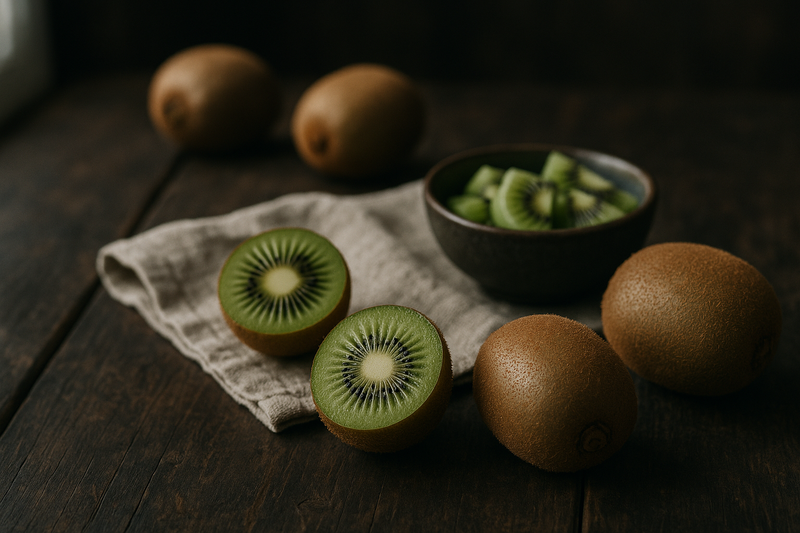
- Kiwi: the best-studied single food for constipation, effective at 2 to 3 fruit per day across multiple randomized trials.
- Prunes: outperformed psyllium for stool frequency and consistency in a randomized crossover trial.
- Chia-seeds and flaxseeds, ground: combine soluble and insoluble fiber that gels with water; always pair with plenty of fluid.
- Oats: a soluble-fiber grain that's gentle to introduce and easy to build a daily routine around.
- Pear, eaten with the skin: fiber plus natural sorbitol for a mild osmotic effect.
- Beans and lentils: added gradually, they build stool bulk and feed fermentation that supports regularity.
Foods to adjust
Low-fiber, highly processed foods (white bread, pastries, most fast food) provide little bulk and commonly displace higher-fiber options at meals; they don't need to be eliminated, but shouldn't form the base of most meals if you're constipated. Be cautious with fiber supplements or fiber-fortified bars taken without enough fluid, since they can worsen the sense of blockage rather than relieve it. Excess unripe banana (high in resistant starch that some people find binding), high dairy intake in those who are sensitive to it, and low overall fluid intake, including caffeine or alcohol without matching water, are also worth reviewing. Increase fiber gradually; adding 25 or more grams in a single day after eating very little fiber commonly causes gas, cramping, and bloating rather than relief.
A short action plan
- Add 2 kiwi or 4 to 6 prunes daily for at least two weeks before judging whether it's working.
- Increase water intake alongside any fiber increase; a simple marker is pale yellow urine.
- Build fiber up gradually over 1 to 2 weeks toward the Dietary Guidelines target of roughly 25 to 34 grams a day for most adults, rather than jumping there in one day.
- Add daily movement, even a 15 to 20 minute walk, which supports colon motility.
- Keep a consistent daily time to try a bowel movement, ideally after a meal, and don't ignore the urge when it comes.
- If there's no improvement after 2 to 3 weeks of consistent effort, see a clinician before adding laxatives long-term or escalating further on your own.
Red flags: when to seek care
See a clinician promptly for constipation that comes with any of the following: blood in the stool or black, tarry stools, unintentional weight loss, severe or worsening abdominal pain, vomiting, an inability to pass stool or gas at all, a hard or noticeably swollen abdomen, iron-deficiency anemia, or constipation that started suddenly after age 50 with no clear cause. A family history of colorectal cancer, or constipation that alternates unpredictably with diarrhea, also warrants evaluation rather than continued self-management. These features can indicate something beyond ordinary functional constipation, and dietary fiber is not an appropriate substitute for that evaluation.
Bottom line
Kiwi and prunes have the best trial evidence of any individual foods for constipation, each matching or beating psyllium in head-to-head studies, but they work as part of a pattern that includes adequate fluid, gradual fiber increases, and regular movement, not as a stand-alone cure. Give changes 1 to 2 weeks. If constipation is severe, sudden, or accompanied by alarm symptoms, see a clinician rather than pushing dietary changes further on your own.
Frequently asked questions
How many prunes or kiwi do I need to eat each day?
Trials showing benefit generally used 2 to 3 kiwifruit a day or about 100 grams of prunes daily (roughly 10 to 12 prunes), split across the day. Starting with less and increasing over a week reduces gas and bloating while your gut adjusts.
Is fiber supplement powder as good as eating whole foods?
Supplements like psyllium are effective and well studied, but in head-to-head trials, kiwi and prunes performed as well as or better than psyllium for stool frequency, likely because whole foods add water content, sorbitol, and other compounds alongside fiber. Either approach is reasonable; whole foods simply add nutrients that supplements don't.
Can too much fiber cause constipation instead of relieving it?
Yes, if fiber is increased quickly without enough water, or if it's mostly insoluble fiber with little fluid, stool can become bulkier without becoming easier to pass. Gradual increases paired with fluid intake avoid this problem.
Does coffee help with constipation?
Coffee, caffeinated or not, stimulates colon motility in many people and can trigger the urge to have a bowel movement. It's a reasonable habit to lean on, but it's not a substitute for fiber and fluid as a daily strategy.
When should I stop trying diet changes and see a doctor?
If there's no meaningful improvement after 2 to 3 weeks of consistent fiber, fluid, and activity changes, or if any red-flag symptom appears at any point, it's time to see a clinician rather than continuing to self-manage.
Sources and evidence
- Kiwifruit and stool frequency in mild constipation, American College of Gastroenterology
- Two gold kiwifruit daily for constipation, randomized trial, PMC
- Randomised clinical trial: dried plums (prunes) vs. psyllium for constipation, PubMed
- Dried plums for chronic constipation, AAFP
- Kiwifruit, prunes, and fiber for chronic constipation, ClinicalTrials.gov
- Food sources of dietary fiber, Dietary Guidelines for Americans
- Diagnosing constipation spectrum disorders in primary care, PMC
Know Your Numbers
Eating healthy is a start. Now get to know your biomarkers.
Food changes bloodwork — inflammation, lipids, blood sugar and nutrient status all respond to what you eat. 59 markers from $59.
- Results in 7–10 days at 2,000+ Quest sites
- Licensed provider reviews every result
- One flat price, no membership, HSA/FSA eligible
Educational information only, not medical advice. Panels are ordered and reviewed through our licensed partner; Plantopedia may earn a commission.