Fermented Vegetables: Methods, Microbes & Nutrition
Brine ferments, dry-salted krauts, bran beds and water kimchi explained — which contain live cultures, how much to eat, and an index of every fermented vegetable on Plantopedia.
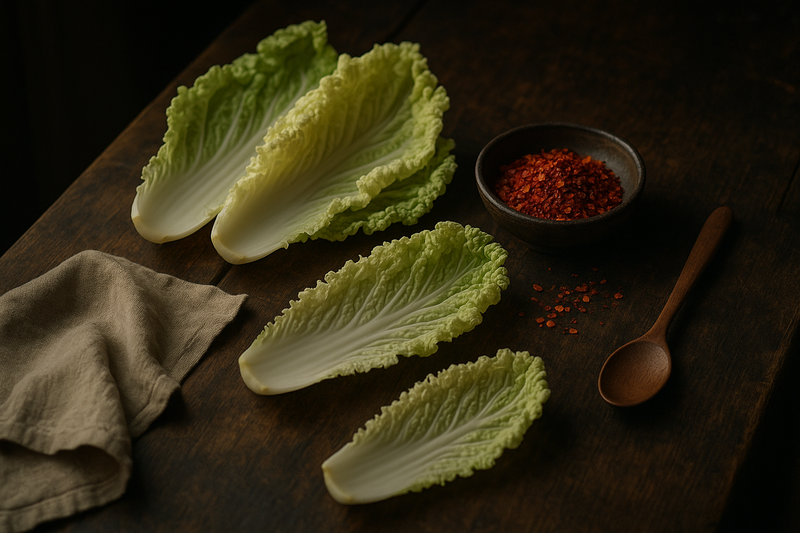
Fermented vegetables are the simplest form of food preservation still in daily use: salt, vegetables, and time. Lactic acid bacteria already present on the produce convert sugars into lactic acid, dropping the pH below roughly 4.6 and making the jar inhospitable to spoilage organisms. The result keeps for months, gains B vitamins and free amino acids, and delivers live microbes when eaten unpasteurized.
This hub links every fermented vegetable on Plantopedia, grouped by the technique used to make it.
Brine ferments versus dry-salted ferments
Dry-salted (mass-salted). Vegetables are shredded, salted at roughly 2% of their weight, and pressed until they release their own liquid. Sauerkraut, Curtido, and Kimchi work this way.
Brine-submerged. Whole or large-cut vegetables sit in a 3–5% salt brine because they cannot release enough liquid on their own. Fermented cucumbers, Fermented carrots, Torshi left, and Pao cai belong here.
Rice-bran and water styles. Nukazuke buries vegetables in a living bran bed, while Dongchimi ferments in a light, drinkable brine. Gundruk is fermented with no added salt at all, relying on wilting and pressure.
The fermented vegetable index
- Kimchi — method, salt ratio, timing, and nutrition
- Sauerkraut — method, salt ratio, timing, and nutrition
- Curtido — method, salt ratio, timing, and nutrition
- Giardiniera — method, salt ratio, timing, and nutrition
- Fermented carrots — method, salt ratio, timing, and nutrition
- Fermented beets — method, salt ratio, timing, and nutrition
- Fermented radishes — method, salt ratio, timing, and nutrition
- Fermented cucumbers — method, salt ratio, timing, and nutrition
- Fermented green beans — method, salt ratio, timing, and nutrition
- Fermented cauliflower — method, salt ratio, timing, and nutrition
- Fermented red cabbage — method, salt ratio, timing, and nutrition
- Torshi left (fermented turnips) — method, salt ratio, timing, and nutrition
- Pao cai — method, salt ratio, timing, and nutrition
- Suan cai — method, salt ratio, timing, and nutrition
- Dongchimi — method, salt ratio, timing, and nutrition
- Zha cai — method, salt ratio, timing, and nutrition
- Nukazuke — method, salt ratio, timing, and nutrition
- Gundruk — method, salt ratio, timing, and nutrition
Are they actually probiotic?
Only if they are unpasteurized. Shelf-stable jars in the ambient aisle have been heat-treated, which kills the bacteria while keeping the acidity and the fiber. Refrigerated products labeled "raw," "live," or "naturally fermented" retain viable Lactiplantibacillus, Leuconostoc, and related species, typically in the 10⁶–10⁸ CFU per gram range in home and small-batch production.
Vinegar pickles are a separate category: they are acidified, not fermented, and contain no live cultures. If the ingredient list starts with vinegar rather than salt and water, it is a pickle, not a ferment.
Salt, sodium, and how much to eat
Fermented vegetables are salty by design — the salt is what selects for lactic acid bacteria over spoilage organisms. A 30 g serving of sauerkraut or kimchi typically carries 150–300 mg sodium. Treat them as a condiment: two to four tablespoons a day alongside meals gives the microbial and flavor benefit without pushing sodium intake meaningfully. If you are sodium-restricted, rinse briefly before serving, which lowers surface salt while leaving the acidity and microbes largely intact.
Start small if you are not used to them. Sudden large servings of live ferments commonly cause bloating for the first week.
Safety in one paragraph
Keep vegetables fully under the brine, use non-iodized salt at 2% by weight for mass-salted ferments or 3–5% for brines, ferment at 60–72°F, and expect visible bubbling within two to three days. White film on the surface is kahm yeast — harmless, skim it. Fuzzy colored growth is mold; discard the batch. A finished ferment should smell sour and clean, never putrid.
Frequently asked questions
Do store-bought fermented vegetables contain live probiotics?
Only refrigerated, unpasteurized products do. Anything shelf-stable at room temperature has been heat-treated, which destroys the live cultures while leaving the acidity, fiber, and flavor intact.
What is the difference between pickled and fermented vegetables?
Pickled vegetables are preserved by adding vinegar. Fermented vegetables generate their own acid through lactic acid bacteria feeding on the vegetables' sugars. Only the fermented version contains live microbes and the amino acids and B vitamins they produce.
How much fermented vegetable should I eat per day?
Two to four tablespoons — roughly 30–60 g — is a practical daily amount. That supplies live cultures without adding excessive sodium, and it is close to traditional consumption patterns in Korea, Germany, and China.
Is the white film on my ferment mold?
A flat, white, sometimes wrinkled film is usually kahm yeast, which is harmless and can be skimmed off. Fuzzy growth that is green, black, pink, or blue is mold, and the batch should be discarded.
Are fermented vegetables safe during pregnancy?
Commercially produced, refrigerated ferments from a reputable maker are generally considered safe, but home ferments carry more variability. Discuss it with your clinician, and avoid any batch that smells off or shows mold.
Know Your Numbers
Eating healthy is a start. Now get to know your biomarkers.
Food changes bloodwork — inflammation, lipids, blood sugar and nutrient status all respond to what you eat. 59 markers from $59.
- Results in 7–10 days at 2,000+ Quest sites
- Licensed provider reviews every result
- One flat price, no membership, HSA/FSA eligible
Educational information only, not medical advice. Panels are ordered and reviewed through our licensed partner; Plantopedia may earn a commission.